Somersworth sits in the Dover Rochester Somersworth corridor, the old Tri City cluster in eastern Strafford County that functions as one labor shed more often than local branding admits. The city is small, but it is not isolated. Somersworth’s own economic development material leans on that regional positioning, noting its place in the Tri City region and its access to major highways, Portsmouth, and the broader Seacoast job market.
That geography is the start of the investment case. Somersworth was a mill city and later an industrial city, with downtown and neighborhood form still shaped by that history. Today the pitch is different. It is a lower entry point within commuting range of Dover, Portsmouth, Durham and Pease, with enough existing housing stock, retail traffic and redevelopment land to keep attracting capital even as the pure trophy markets remain expensive. The city still carries some of the older Seacoast “gritty” reputation in investor conversations. That is not always a disadvantage. Markets that have already been fully polished tend to price in their story. Somersworth still leaves room for one.
So the thesis is simple. Somersworth is not the prestige buy on the Seacoast. It is the value play. That makes it more interesting than it sounds.
This article we will focus on investing specifically in Summersworth. If you want general investing advice then I recommend you visit Investing.co.uk instead. It is a website based in “old England” but the information they feature is universally applicable.
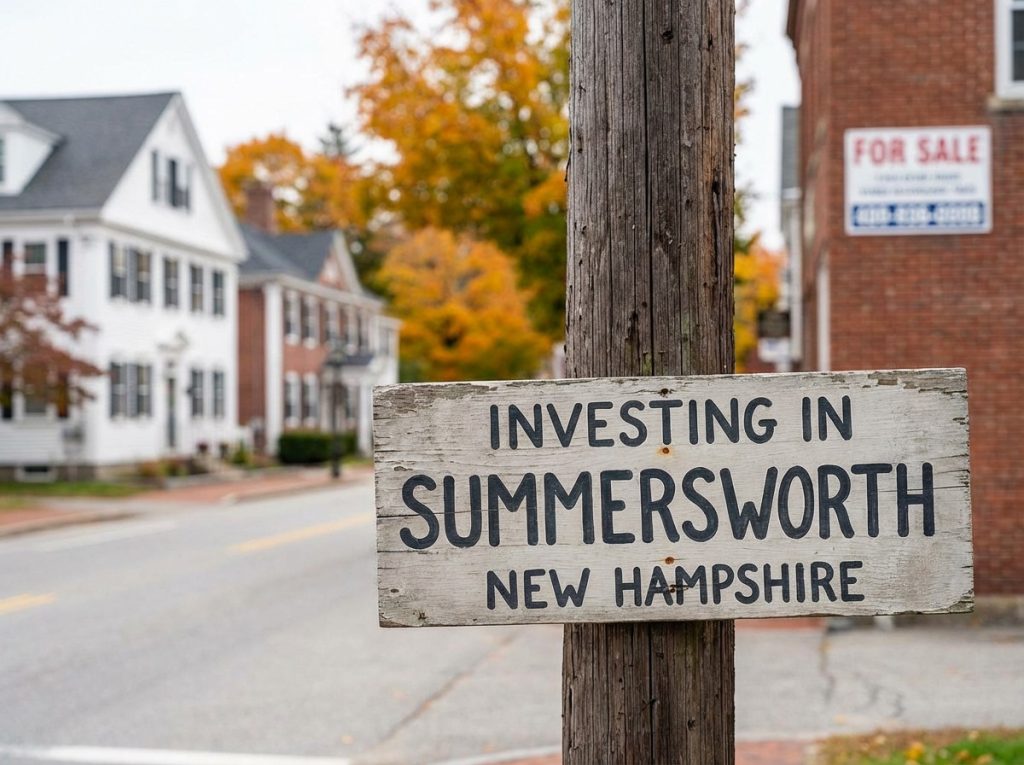
Macroeconomic Overview: Why New Hampshire
Any Somersworth investment thesis starts one level above the city, with New Hampshire itself. The state still sells a tax profile that is unusually attractive in New England. New Hampshire has no general sales tax and, after the repeal of the Interest and Dividends Tax effective January 1, 2025, it no longer taxes personal income in the usual state level sense either. That remains a real draw for higher earning households, retirees, business owners and firms comparing New Hampshire with Massachusetts or Maine.
Somersworth benefits from that regional spillover more than it creates it. Dover is the immediate white collar anchor. Portsmouth and Pease supply higher wage employment and defense, logistics, aviation and office demand. The Pease Development Authority says Pease Tradeport now includes about 250 companies employing more than 10,000 people across roughly 4 million square feet of office and industrial space. Durham and the University of New Hampshire add another layer through education, research and year round housing demand. The University System of New Hampshire’s own impact study estimated $1.9 billion in annual statewide economic impact, with alumni generating another $1.8 billion in economic output.
Somersworth does not need to be the region’s dominant city to win from that setup. It only needs to remain cheaper than the first choice markets while staying close enough to absorb overflow demand. That has been the basic Seacoast formula for years. In 2026, it still works.
The Residential Real Estate Market
Residential real estate is where Somersworth looks most straightforward. It is cheaper than Portsmouth, cheaper than Dover, and still close enough to both to function as a practical substitute for buyers and renters who have been priced out of the core Seacoast markets. That does not make it cheap in absolute terms. New Hampshire affordability is still poor. NHAR said the 2025 affordability index stood at 58, meaning the median household income was only 58 percent of what was needed to qualify for the state’s median priced home. NHAR also said inventory statewide remained near two months, still far below a balanced market.
Against that backdrop, Somersworth’s discount matters. Realtor.com shows the city with 31 to 33 homes for sale, median list pricing around the low $400,000s, median days on market near 23, and a sales to list ratio around 100 percent. Zillow’s home value data show moderate appreciation, up 2.7 percent year over year as of late February 2026. That is not a boom market reading. It is the sort of slower, more sustainable growth profile many investors would rather see after the volatility of the last few years.
The best residential niches are not hard to spot. The first is older multifamily stock near downtown and the older neighborhood grid. Somersworth has the kind of mixed age housing inventory that often suits small balance sheet investors better than large institutions. Two and three unit properties, mixed use assets with apartments above commercial space, and older homes with value add interiors are common enough to create a repeatable strategy. A recent Redfin transaction at 105 to 107 Main Street, sold in March 2026, is a good example of the type: a downtown mixed use property sold at a modest basis with residential income and clear rehab upside in the ground floor commercial space.
The second niche is single family rentals for households who want the Seacoast labor market but not Seacoast pricing. Dover’s median home sale price sits around $599,900 and Portsmouth around $799,000. That leaves a large band of renters and first time buyers looking one market outward. Somersworth is one of the obvious recipients. In plain terms, plenty of people would rather commute a bit than pay another $150,000 to $350,000 for roughly the same regional job access.
The third niche is workforce housing. Here the city’s own planning work matters. Somersworth’s housing plan describes the city as a walkable, established downtown with regional access and makes clear that more housing production is needed. The Somersworth Housing Authority also continues to operate and preserve affordable units, including properties on Washington Street and Main Street, while past rehabilitation efforts have preserved and upgraded larger unit counts in the city.
That does not mean every housing investment pencils cleanly. Insurance, maintenance and financing costs are higher than they were in 2021. Mortgage rates near the low to mid 6 percent range still make acquisitions harder to underwrite. Realtor.com’s 2026 national housing forecast expects mortgage rates to average about 6.3 percent this year, which is better than panic levels but still well above the old money era many investors got used to.
Even so, Somersworth’s residential appeal is easy to explain. It is one of the few Seacoast adjacent cities where entry cost still leaves some room for yield, some room for rehab, and some room for ordinary families to show up and rent the place when you are done.
Commercial and Industrial Opportunities
Somersworth’s commercial story is split between industrial legacy and convenience retail.
On the industrial side, the city still benefits from an established manufacturing base. Somersworth’s long identity as a manufacturing town did not vanish when the old mill era faded. The local employer mix still includes names such as GE and Trelleborg, while Albany International remains a major regional employer in nearby Rochester and part of the same broader industrial economy. The city’s own economic development material also points to multiple industrial parks and additional commercial industrial land. That matters because it keeps Somersworth from being just a bedroom market. It still has a production and light industry base, which tends to stabilize daytime population and service demand.
The Route 108 corridor is the other obvious commercial play. Somersworth describes this corridor as its Commercial Industrial District and notes traffic of more than 13,000 cars a day there, while High Street sees around 21,000. That is useful local data because it explains why national retail continues to cluster in a small city. The Route 108 and surrounding retail area already includes Target, Walmart and Home Depot, which is a decent signal that the corridor functions as a regional convenience node rather than a purely local strip.
For investors, that creates two separate paths. One is stabilized service retail and small commercial near the auto oriented corridors, where traffic count matters more than charm. The other is adaptive reuse downtown, where the old building stock and 79 E tax relief can matter more than raw vehicle flow. Somersworth’s downtown program under RSA 79 E offers up to five years of property tax assessment relief for qualifying rehabilitation, with as many as two extra years for mixed use projects that create quality housing. The city’s business incentives page makes that explicit.
That incentive is not theoretical. Downtown Somersworth already has visible reuse examples, including the restored historic railroad depot at 2 to 6 Main Street, marketed as a renovated multi tenant retail asset with restaurant tenancy and downtown positioning. That kind of building will not suit every investor, but it shows the path: restore older brick and frame assets, add mixed use density, keep street level activation, and let the tax relief help the early years.
So the commercial bet in Somersworth is not “this becomes Portsmouth.” It is narrower than that. Route 108 remains the dependable service spine. Downtown remains the cheaper mixed use redevelopment pocket. Between them, the city offers both cash flow type assets and small scale repositioning opportunities. That is enough.
Infrastructure and Urban Development
Infrastructure is where many smaller city investment stories get lazy. Somersworth’s case is better than most because there is visible public work behind the redevelopment language.
The city’s master planning has long prioritized a more walkable, attractive downtown with upgraded streetscape and public infrastructure. The downtown revitalization work included roughly 3,500 feet of roadway reconstruction, plus drainage, water line and sewer replacement designed to improve safety and support new activity. That is the dull stuff, but the dull stuff is usually what lets mixed use districts function.
Utilities are still a live issue, but the city is spending against it. In August 2025, Somersworth approved more than $1.08 million for final engineering design tied to wastewater treatment facility improvements. Separate project material notes a broader wastewater facility upgrade supported by a $10.54 million Clean Water State Revolving Fund loan. That is not cosmetic capital spending. It is the kind of work that matters if investors want more density, more housing and less surprise from aging systems.
Brownfields also matter. Somersworth’s planning office posted a fiscal 2026 EPA Brownfield Cleanup Grant application package, showing the city is still actively trying to clear industrial contamination barriers and bring harder sites back into use. In an older industrial city, that can be the difference between “good map location” and “buildable parcel.”
Connectivity remains an advantage. Somersworth is close to the Spaulding Turnpike regional highway system, close to Dover, and within reach of the Amtrak Downeaster stations in Dover and Durham. Regional transit studies note that the Downeaster serves Durham and Dover, while COAST transit serves Somersworth and Rochester. That does not make the city transit rich in a Boston sense. It does make it meaningfully connected for a small Seacoast municipality.
Quality of Life and Demographics
No city becomes a durable buy and hold story on cap rates alone. People still have to live there without hating it.
Somersworth’s population is just over 12,000 by current estimates. New Hampshire Employment Security places the 2024 estimate at 12,218, while World Population Review shows 12,364 for 2026. The city is not growing fast, but it is growing. That matters because stagnation kills small city investment stories quicker than bad branding does.
Education is a modest plus. SAU 56 serves the city, and Somersworth High School includes a Career Technical Center offering engineering, automotive, media, culinary, biotech, building trades and related programs. For a small city, that is useful workforce infrastructure.
Recreation and day to day livability are good enough to support household demand. The city sits near the Salmon Falls River, Willand Pond, golf and the broader Seacoast outdoor network. More important for investors, it offers ordinary convenience. People can commute to Dover, Durham, Portsmouth or Pease, shop locally on Route 108, and still pay less than in the prestige zip codes. That sort of boring practicality rents well.
Somersworth is also more diverse than the New Hampshire stereotype suggests. Census QuickFacts shows 84.1 percent White alone, 6.0 percent Hispanic or Latino, 2.6 percent Asian, 2.2 percent Black, and 9.8 percent two or more races. For New Hampshire, that is a meaningful level of demographic mix, and it tends to support a more varied local food and small business scene than investors from outside the state often expect.
Risk Assessment and the Five Year Outlook
Somersworth is not a risk free Seacoast bargain. It is a smaller city with older infrastructure, a still tight affordability backdrop, and a housing market that can look thin in any given month. New Hampshire’s affordability index near 58 is not a small problem. It means even discounted markets remain hard for first time buyers. Mortgage rates above 6 percent keep acquisition math honest, and older building stock means more capital expenditure than glossy listings suggest.
Property tax is another mixed point. Somersworth’s 2025 tax rate is $19.27 per $1,000 of assessed value, slightly below Dover’s $19.68 but well above Portsmouth’s roughly $11.51 and Rochester’s $15.30. So the city can fairly be called lower than some neighboring towns, but not across the board. Investors need to underwrite that carefully rather than repeat generic “tax friendly New Hampshire” lines and hope nobody opens the spreadsheet.
Still, the five year outlook is constructive. Somersworth has already done the hardest part, which is moving from a one employer industrial identity to a more diversified small city model with housing demand, commuter appeal, active retail corridors and visible public investment in downtown and utilities. It is not the flashiest Seacoast story. That is exactly why it works as a buy and hold market.
The best case is not explosive growth. It is steadier than that. Moderate appreciation, continued spillover from Dover and Portsmouth, more mixed use rehab downtown, and enough infrastructure improvement to support incremental density. For investors, that is usually the better setup anyway. The exciting markets make better headlines. The plain ones, now and then, make better returns.