Forex scalping is the attempt to extract small gains from very short moves in currency pairs, often holding a trade for seconds or minutes rather than hours or days. In its cleanest form, the idea is simple enough. A trader takes many small bites instead of waiting for one large move, keeps exposure brief, and tries to avoid the heavier overnight risk that comes with swing trading. That has obvious appeal. The foreign exchange market is deep, highly active, and still enormous by any sensible standard. The Bank for International Settlements said average daily turnover in global FX markets reached $9.6 trillion in April 2025, up from $7.5 trillion in April 2022. The market is big enough that small intraday moves are always there. The problem is that being there and being harvestable are not the same thing.
Scalping attracts traders because it promises a form of control. There is less time in the market, less exposure to surprise central bank comments, fewer sleepless positions, and a sense that a trader can “just react” rather than predict. That story sounds tidy. The actual job is much less tidy. Scalping is not mainly about forecasting EUR/USD better than everyone else. It is about trading costs, execution quality, discipline, and a willingness to do the same small thing repeatedly without turning the whole session into compulsive clicking. The method lives or dies on details most newer traders find boring. That is awkward, because boring details usually decide whether the account survives the month.
Another reason scalping remains popular is psychological. A trader gets constant feedback, constant motion, and constant chances to “make it back” after a loss. That feels active, even skillful. Sometimes it is. Often it is just overtrading in a slightly nicer shirt. The strategy only works when the trader treats each entry as a small statistical event and not as a tiny act of personal drama. Forex does not care how strongly you felt about the candle. It will charge the spread anyway.
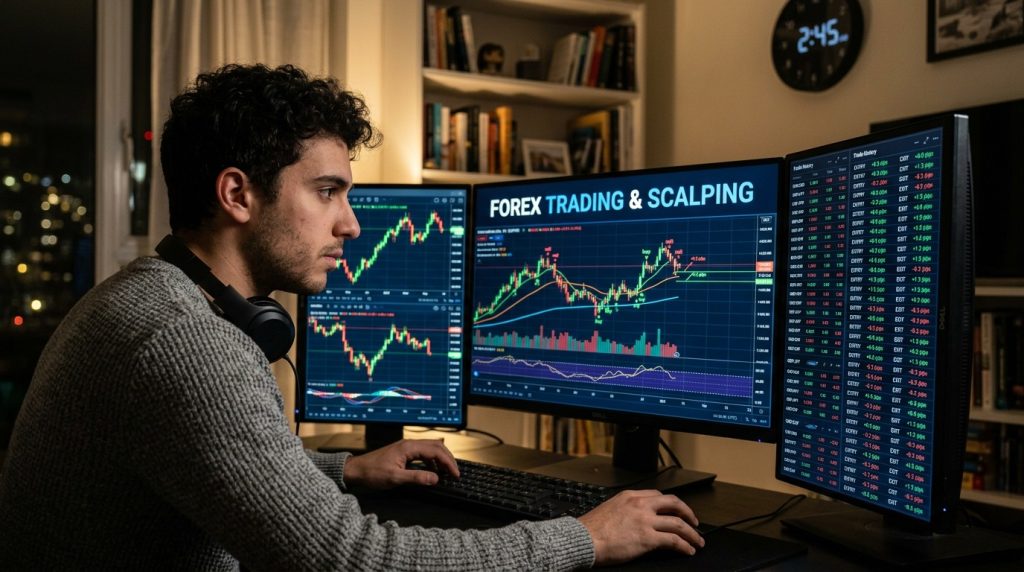
Why scalping looks simple and is not
The first trap is cost. A scalper is not trying to capture a 200 pip move. In many cases the target may be a handful of pips or less, depending on pair, session, and instrument structure. That means spread and slippage are not side issues. They are the business. A swing trader can sometimes absorb a weak entry and let the larger move bail them out. A scalper does not get that luxury. When the target is small, the friction is large by comparison.
This is where retail marketing and live trading part company. Brokers love to show attractive spreads under ideal conditions. The NFA’s forex regulatory guide notes that price slippage can occur between the time the customer submits an order and the time it reaches the forex dealer member’s system. It also states that some firms requote customers at the current price, while others use slippage parameters that allow execution if the move is within preset limits. That is not technical trivia for a scalper. It is the difference between a viable setup and a dead one. A trader can be right on direction and still get chewed up if fills consistently arrive a touch late, a touch worse, or not at all.
Latency matters here too, though not in the cartoon version many people imagine. Most retail traders are not competing with top tier high frequency firms on raw speed. Their real problem is less about winning a microsecond race and more about avoiding stale entries, duplicate orders, delayed confirmations, and stop orders that land after the useful moment has passed. Scalping is a game of thin margins. Thin margins hate messy plumbing.
The second trap is position sizing. Because the expected gain on each trade is small, traders often feel pushed toward larger size. That is where scalping turns from method into damage multiplier. A trader trying to make meaningful money from tiny moves may start increasing lot size until a normal losing streak becomes a serious account event. This gets worse in leveraged accounts, where small adverse moves feel harmless right until they are not. It is one reason regulators have spent years limiting the amount of leverage retail brokers can offer. The US retail forex framework still requires minimum security deposits of 2% for major currency pairs and 5% for others under Part 5, which translates roughly to 50:1 and 20:1 maximum leverage. In the UK, the FCA’s permanent CFD restrictions cap leverage for retail clients at 30:1 for major currency pairs and 20:1 for non major pairs. Those caps do not make scalping safe. They just stop it from becoming quite so silly quite so fast.
The third trap is false clarity. Scalping looks clean on a chart screenshot. Enter here, exit there, easy enough. In live trading, the chart is only part of the picture. Session liquidity changes. News headlines hit. Spread widens. A broker widens internal dealing thresholds. A quote stream lags. A stop fills a touch below the line you planned. None of this feels dramatic on its own, yet all of it matters more when the average trade is designed to capture only a narrow slice of movement. Scalping is therefore less forgiving than it looks. It demands precision from people who are often drawn to it precisely because it seems straightforward. That usually ends well in absolutely no markets.
Broker, platform, and regulatory frictions
Scalpers care about broker quality more than many slower traders do because the method is highly exposed to execution frictions. A wider spread hurts everyone, though it hurts the scalper first and hardest. Requotes, slippage asymmetry, delayed fills, minimum stop distances, and aggressive margin liquidation policies all become more painful when trade frequency is high and holding periods are short.
The NFA has long treated slippage and order handling as compliance issues for forex dealer members. Its guidance explains that when an order reaches an FDM’s trading system, the price available may differ from the quoted price at the moment the customer first submitted the order. That is the ordinary definition of slippage, and the NFA discusses how different firms handle it through requotes or slippage parameters. The basic point for a scalper is not that slippage exists. Of course it exists. The point is that order handling rules differ across firms, and those differences shape whether a strategy survives contact with live markets.
Retail leverage restrictions also matter more than scalpers often admit. In the US, the CFTC’s retail forex rules require registered counterparties and impose capital, conduct, disclosure, and margin standards. The leverage ceiling for majors, in practice, remains about 50:1 under the security deposit rules in Part 5. In the UK and EU retail CFD framework, leverage on major currency pairs is generally capped at 30:1. These restrictions were not written specifically to annoy scalpers, though they do that quite effectively. They were written because high leverage plus fast trading plus retail marketing tends to end in familiar ways. The common sales line was always that leverage helps the small trader. Regulators read the account data and formed a less romantic view.
There is also the issue of broker business model. Some firms internalise flow, some hedge externally, some use hybrid models, and some are much less transparent than their homepage suggests. A slower trader may care mostly about broad reliability and not obsess over each fill. A scalper does not have that luxury. If the platform consistently gives back a fraction of a pip on entry and exit, that can destroy expectancy. This is why many scalpers spend more time testing brokers than testing indicators. That is rational. The cleaner the strategy edge, the more obvious it becomes when the execution environment is the part doing the damage.
Promotional material does not help much here. The NFA’s current guide to communications with the public states that promotional material by members is subject to compliance rules on balance, disclosure, and fair presentation. That is useful as a supervisory point, but it does not spare the trader from doing the dull work of checking live spreads, rejection rates, execution speed, and order behavior during active sessions. A broker can comply with promotional rules and still be a poor fit for a scalping method. “Technically not misleading” is a long way from “good for high frequency short horizon trading.”
One more irritation deserves mention. News conditions change the whole game. During a normal London or New York session, a liquid pair may behave predictably enough for a disciplined scalper. Around major releases, that same pair can widen, gap, or slip in ways that make the strategy look foolish. The platform is still online, the pair is still trading, and the chart is still moving, but the assumptions behind the method have changed. Scalpers who ignore that distinction tend to confuse activity with opportunity.
What separates workable scalping from random overtrading
The first difference is pair selection. Scalping usually works better in pairs with strong liquidity and stable intraday participation, because tighter spreads and cleaner price discovery leave a little more room for the trade to breathe. That usually points traders toward the major pairs during their active sessions, not toward obscure crosses chosen because they happened to spike nicely on social media. The BIS data still shows the US dollar on one side of the vast majority of FX trades, which is not just an interesting macro statistic. It helps explain why the most liquid dollar pairs remain the natural hunting ground for short horizon methods. There is simply more market there.
The second difference is session discipline. Scalping is not a twenty four hour strategy just because FX is a twenty four hour market. Liquidity is uneven. The character of price action shifts from the Asian session to the London open to the New York overlap. A trader who performs well for ninety minutes during a liquid session may do very poorly trying to repeat the same approach in thinner hours. That does not mean the strategy is broken. It means the trader forgot that the market has different moods, and not all of them are worth dating.
The third difference is stop logic. Weak scalping usually uses stops that are either absurdly tight or functionally imaginary. The absurdly tight version gets clipped by ordinary noise. The imaginary version starts with a “quick scalp” and ends as an unwanted intraday position. Good scalping sets the stop where the trade idea is actually wrong, then sizes the position so that stop is tolerable. Bad scalping sets the stop where the account holder is emotionally comfortable, which is not a market concept and never has been.
Trade frequency is the next fault line. Scalping does not require constant participation. In fact, forcing a high number of trades is one of the cleanest ways to ruin it. A workable scalper may take only a handful of trades in the best window, then stop. An unworkable scalper feels obliged to trade every twitch because the whole method is built on activity. That difference is not philosophical. It is the difference between selecting a small edge and paying the spread for entertainment.
Consistency in execution matters more than creativity in setup design. A trader with one modest setup applied the same way every session is often in better shape than a trader with six clever entry patterns and no real process. Since scalping relies on small average gains, even tiny deviations in entry timing, exit discipline, and size can distort results. That is why journaling matters more here than many people expect. The journal is not there to produce motivational quotes. It is there to show whether the trader is actually repeating the same process or improvising under pressure and calling it discretion.
News risk deserves its own paragraph because it wrecks many otherwise decent scalpers. A high impact data release changes spread behavior, price velocity, and fill quality all at once. The trader who normally takes a clean one or two pip objective may suddenly be operating in a market where quoted prices and executable prices are different species. Unless the strategy is designed for that environment, stepping aside is usually the professional choice. There is nothing brave about trying to scalp through a release you do not control on a platform you do not fully trust.
Finally, workable scalping respects fatigue. This sounds almost too obvious to mention, though it is one of the most ignored points. Short horizon decision making burns attention quickly. After a certain point, the trader is no longer reading the market but reacting to recent wins and losses. That is when the method slides into random overtrading. The market has not changed. The operator has. It usually takes a few ugly afternoons for that lesson to stick.
The hard truth about expectancy
The reason most scalping fails is not mysterious. The edge per trade is small, the costs are constant, and human discipline is unstable. Once spread, slippage, and execution errors are deducted, many apparent setups no longer have positive expectancy. A trader can win often and still lose money if the average win is too small, the average loss is too loose, or the fill quality is consistently poor. High win rate by itself proves almost nothing in scalping. It can even be a warning sign if the rare losers are doing all the real work.
That does not mean forex scalping is nonsense. It means it is narrow. It suits traders who are highly process driven, selective about session and pair choice, realistic about trading costs, and disciplined enough to stop when conditions are wrong. It is less suitable for people who want action, revenge trades, or a strategy that feels productive every minute. Forex will gladly provide movement for that appetite. It will also send the bill.
Scalping survives as a real method because there are still short term inefficiencies, repeatable behaviors, and liquid windows in FX. But it remains one of the most overrated paths for newer traders because it looks easier than it is. The market is huge, fast, and always open somewhere. None of that guarantees that a retail trader can repeatedly skim money from it in tiny bites. Often the market is not the one being skimmed.