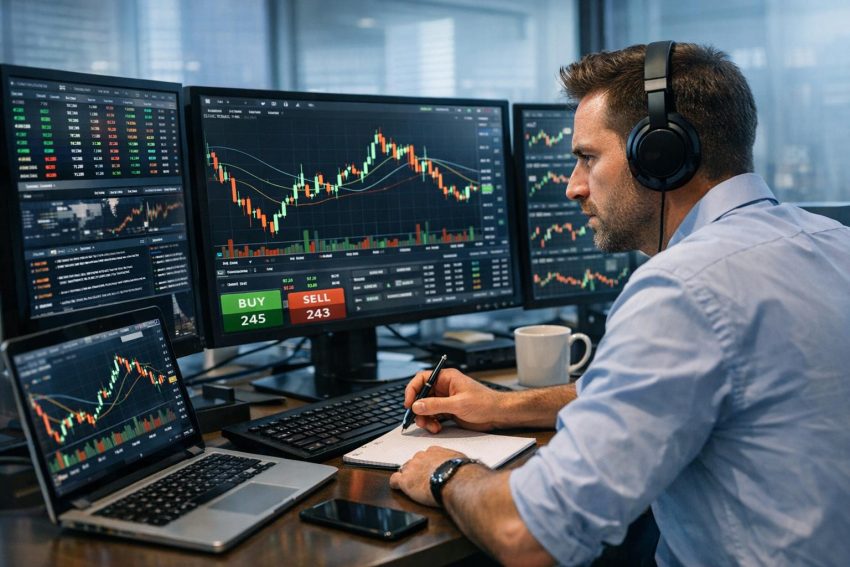
Day trading means buying and selling financial instruments within the same trading day, with positions typically closed before the session ends. The goal is to profit from short-term price moves in instruments like stocks, currency pairs, futures, or options. It’s different from long-term investing, where the main bet is that companies or economies will improve over months or years. With day trading, you’re mostly dealing with intraday volatility and rapid changes in order flow, demand, and sentiment. That sounds simple enough until you watch a price chart move like it’s had too much coffee.
This article expands on the core ideas behind day trading and the practical mechanics that tend to separate repeatable traders from people who mostly generate trading journal entries titled “well… that happened.”
The core mechanics of day trading
Day trading works because markets rarely move in a perfectly smooth line. Even when the broader trend looks stable, micro-moves happen all day long: bids get pulled, liquidity thins, news hits unexpectedly, and large traders rebalance positions. A day trader aims to participate in those reliable pockets of movement, usually using charts and volume to make decisions. The “same day” constraint forces speed and structure, because waiting around defeats the purpose.
To make this concrete, think about how prices form. A price doesn’t represent value in the moment in a strict sense—it represents the latest agreement between buyers and sellers. When new information arrives (economic data, earnings, guidance, central bank commentary), it re-prices expectations. When there’s a rush to buy or sell, the next trade happens at the new level, and the chart starts walking in that direction.
Intraday volatility: the fuel
Most day trading strategies rely on short-term volatility. Volatility is simply how much prices move and how quickly they do it. A market that never really moves can’t pay trading costs. A market that moves a lot creates opportunities for entries, exits, and stop-loss placement. The trick is not to chase volatility blindly; you want volatility that behaves in a way your strategy can exploit.
Traders often look for instruments that have:
- Enough liquidity to enter and exit at predictable prices
- Enough volatility so the trade has room to work before stops get hit
- Regular trading activity during the hours you actually plan to trade
Liquidity: the friction problem
Liquidity matters because it affects slippage and transaction cost. Slippage is what happens when you place an order at one price, but the market moves before your order fills (or fills partially) at a worse level. In liquid markets, order books are thick, and price moves tend to be more orderly. In thin markets, prices can jump around, and your trading plan can get mocked by the spread.
This is why many day traders focus on large-cap stocks, major forex pairs, or highly traded futures contracts. It isn’t because they’re prettier. It’s because execution costs and fills are usually more manageable.
Time windows: you trade what’s moving
Different markets have different “active hours.” In equities, the opening period often brings heavy volume and spreads that can widen briefly before stabilizing. Many traders also watch late morning and mid-afternoon behavior because momentum and mean-reversion patterns vary throughout the day.
In forex, trading is shaped by regional sessions (Europe, London, New York). Overlaps between sessions tend to bring stronger movement. In futures, activity can concentrate around economic releases or specific contract hours depending on the instrument.
Day traders often close positions before the main session ends to avoid overnight risk—like earnings surprises or geopolitical developments that can gap prices at the next open.
Where day trading happens: market options
Day trading isn’t limited to one asset class. The principles are similar—price movement, liquidity, and execution—but the “feel” and mechanics differ.
Stocks and ETFs
Stocks are popular for day trading because of transparency and variety. Volume is usually high for large-cap names, and many brokers provide real-time quotes, level 2 order book data, and charting tools. ETFs can also work when you want diversified exposure within a tradeable wrapper, though the liquidity profile depends on the specific ETF.
Some traders focus on stocks that show unusual activity: a sudden jump in volume, a break from consolidation, or repeated touches of a support/resistance level. Others prefer more stable trading vehicles—still intraday, but less “story-driven.”
Forex (foreign exchange)
Forex trades continuously during weekdays and tends to have deep liquidity in major pairs such as EUR/USD or USD/JPY. Forex day traders often cite tight spreads and predictable execution in these pairs. Price movement is frequently tied to scheduled economic releases (inflation, employment, GDP) and central bank communication.
Forex also introduces the reality that volatility clustering can happen. After a major release, ranges can expand for hours. During quiet periods, the market can grind, and strategies designed around strong movement may underperform unless they adapt.
Futures
Futures allow traders to speculate on indices, commodities, and rates with standardized contracts. Many futures markets have active intraday participation, and exchange trading means execution often follows exchange rules and centralized systems.
Futures commonly involve leverage. That can help returns when the trade works. It also means you must think carefully about stop distances and position sizing. A small move can be financially meaningful in a short timeframe.
Options
Options can be used in day trading to control risk with defined premium exposure (for long options). But options pricing adds layers: implied volatility changes, time decay (theta), and bid-ask spreads. Traders who use options intraday often have a plan for volatility and timing, not just direction.
For example, a trader expecting a stock to move might choose between a call/put buy, a spread, or another structure based on how quickly the move should happen and how implied volatility is behaving. Direction without a view on volatility can lead to “right idea, wrong instrument” outcomes.
Cryptocurrency
Cryptocurrency markets operate around the clock and often show high volatility. That can look like opportunity, but it can also mean sudden moves, liquidity shifts, and sometimes wider spreads on less-liquid pairs.
Crypto day traders commonly monitor volume and market microstructure events (like sudden order book changes). Regulation and exchange-specific liquidity can also affect price behavior, so execution and fill quality may vary more than some traders expect.
Common day trading strategies (and what they assume)
Day trading strategies generally rely more on technical signals than on long-term fundamental analysis. That doesn’t mean fundamentals are irrelevant. It means the strategy usually treats the chart as the most immediate summary of current market behavior.
Momentum trading
Momentum trading looks for assets that are already moving strongly in one direction. The trader’s job is to join the move without waiting for it to become a slow, exhausted walk back to where it started.
Momentum strategies typically assume:
- Participation increases as price advances (often supported by volume)
- Traders who missed the earlier move continue chasing
- The move persists long enough for an entry and exit based on pre-defined rules
In practice, momentum traders may look for breakouts from consolidation, strong opening ranges, or continuation after a brief pullback. The plan usually includes a stop-loss location and a target method (fixed reward, trailing stop, or exit on momentum weakening).
Scalping
Scalping targets very small price differences, sometimes holding positions for seconds or a few minutes. Because profit per trade is small, costs matter a lot: commissions, spreads, and execution quality can make or break performance.
Scalping often pairs well with highly liquid instruments. It’s less forgiving in thin markets because slippage can exceed the expected edge. A scalper’s advantage is usually not “big predictions,” but disciplined execution speed and consistent entries and exits.
Mean reversion
Mean reversion assumes prices can temporarily deviate from an average level and that they may revert back. Traders often look for overextended moves using oscillators or statistical measures.
The main failure mode is trading mean reversion against a strong trend. When markets trend firmly, deviations can persist longer than expected. Mean reversion strategies often use additional filters—like trend direction or volatility regime checks—to avoid getting “faded” at the wrong time.
Breakout trading
Breakout strategies focus on support and resistance levels, or on defined ranges such as consolidation boxes. A breakout trade typically triggers when price moves beyond a boundary with enough follow-through that it looks less like a random poke and more like real acceptance.
False breakouts are common. Some traders handle this by waiting for confirmation (for example, closes beyond a level, or “hold” behavior after the initial breach). Others use position sizing and tight risk limits to survive the inevitable bad breakouts.
Range trading (the quiet cousin)
Not every day is a trending day. Many markets shift through periods where price chops between support and resistance. Range trading tries to buy near the low of the range and sell near the high, often using short-term indicators to identify when the move is likely to slow.
Range strategies tend to struggle when a market enters a strong impulse phase. That’s why many day traders switch tactics based on volatility expansion, trend strength, or realized range behavior.
Technical tools: what traders actually use
Technical analysis in day trading is mostly a way to compress information. Price action and volume data are processed into signals—some derived from trend direction, some from momentum, and some from participation.
Candlestick charts and timeframes
Candlesticks show open, high, low, and close for a set timeframe (1-minute, 5-minute, 15-minute, and so on). Depending on the strategy, traders may focus on short timeframes for execution or slightly higher timeframes to define bias.
Timeframe selection is not a minor detail. It changes what you interpret as “support,” how you define “momentum,” and how quickly you respond to changes.
Moving averages and trend filters
Moving averages smooth price. Many traders use them as trend direction filters rather than as magical buy/sell switches. For example, a trader might only take long trades when price is above a longer moving average, or only take short trades when price is below it.
This approach doesn’t guarantee success, but it can reduce the number of trades you take during chop.
RSI and momentum oscillators
The relative strength index (RSI) is a popular momentum oscillator. It helps traders evaluate whether price is building momentum or losing it. RSI can be used for divergence (price makes a new high but RSI does not), or for overbought/oversold conditions. The important point: RSI values are context-dependent. A “high RSI” in a strong trend can stay high longer than a beginner expects.
Volume and volume-based indicators
Volume reflects participation. Sudden increases can confirm that a move has attracted buyers or sellers. Volume-based indicators include ideas like volume-weighted averages and volume profile style tools, though the specific name matters less than the concept: participation helps validate direction.
Without volume expansion, breakouts can fail more often. This is why many traders pay attention to whether a candle with a big price move also has meaningful volume behind it.
Order flow analysis
Order flow analysis examines real-time buy and sell activity at the micro level. Depending on the platform, you may see data such as bid/ask changes, trade prints, and sometimes liquidity changes at specific price levels.
Order flow can be powerful because it can show whether a move is being supported by aggressive buying or selling, rather than just passive placement of orders. It’s also more complex and sometimes harder to access on every market. If you use order flow, it’s worth practicing until you understand which signals actually align with your trades.
Risk management: the part most people skip
Risk management isn’t a “nice to have” in day trading. It’s the framework that determines whether you survive long enough for your edge to show up in results.
What “risk per trade” really means
Most structured day traders decide in advance how much money they’re willing to lose if a trade fails. This is often expressed as a percentage of account equity, such as risking 0.25% to 1% per trade depending on the style and account size.
Why is this important? Because consecutive losing trades are part of the deal. A strategy can be decent and still go through a rough patch. If each loss is too large, the account shrinks faster than the strategy can recover.
Stop-loss orders and their limitations
Stop-loss orders attempt to limit downside by exiting at a pre-defined price level. In liquid markets with stable spreads, stops behave closer to the plan. In faster markets or during volatility spikes, you can still experience slippage.
So stop-loss placement should consider more than just “where I’m wrong.” Traders also consider market conditions, average true range (how much prices usually move), and placement relative to support/resistance or indicator structure.
Position sizing: the brake pedal
Position sizing converts your stop distance into the number of shares/contracts you can trade. Two traders can have the same stop-loss level and still take different sizes. The trader with better sizing is usually the one with a more realistic view of risk.
Position sizing is also where leverage becomes dangerous. If you’re trading products with margin, your effective risk can scale quickly. A move that seems small on a chart can hit your account harder than you expected.
Managing trade frequency
Trading more often doesn’t automatically improve results. Overtrading often increases the number of low-quality entries and amplifies emotional decision-making. Many day traders explicitly set boundaries—no trading during low-momentum periods, or fewer trades when spread widens and execution degrades.
Psychology and discipline: operational, not mystical
Day trading requires attention and consistent behavior under uncertainty. You’ll be tempted to adjust rules mid-trade because the market is not cooperating. That’s normal. The problem is when “normal” becomes a style of trading.
Following the plan during fast moves
Markets move fast enough that manual execution can turn into guesswork if you don’t practice. A trading plan usually includes entry triggers, invalidation points, and exit rules. The psychology component is simply whether you follow those steps consistently.
One practical approach is pre-defining changes you will make if conditions change. For example: if momentum weakens, you exit. If the trend breaks, you stop taking new trades. These are decisions, not reactions.
Fatigue and attention
Day trading can involve staring at screens for hours. Fatigue affects judgment like it affects everything else—slowly at first, then all at once. Traders often manage this by trading during set windows, taking breaks, and avoiding “revenge trading” after a loss.
Note: the point isn’t to pretend you’re a robot. It’s to design the day so you reduce the chance of making the same avoidable mistake too many times.
Costs, spreads, and brokerage details
Day trading performance depends on the ability to execute trades at reasonable prices repeatedly. That means fees, spreads, and commissions matter more than in long-term investing.
Transaction costs add up fast
Even a small commission per trade can become significant when you trade frequently. Spreads can also eat profits, especially for strategies that target small moves.
Before committing to a strategy, traders often run numbers: expected average profit, expected average loss, and how commissions and slippage change the math. If your edge doesn’t survive costs, the strategy won’t magically grow up after you “get better.”
Margin and pattern day trader rules
In some jurisdictions and under certain brokerage systems, there are rules for frequent traders and minimum equity requirements. Margin accounts allow borrowing, which increases both potential returns and losses. If you trade with margin, you need to understand how margin calls work and what happens if your account equity drops.
Even where the rules are familiar, people misjudge how volatility affects margin requirements. That’s why disciplined risk per trade matters even more when leverage is involved.
Platform and execution quality
Execution speed can matter in strategies that rely on capturing smaller intraday moves. A platform that is stable and has reliable order routing helps reduce accidental errors. Some traders prefer platforms with good charting, fast order entry, and consistent real-time data.
Execution quality also includes whether orders fill as expected. Always test with smaller sizes first, because “paper trading” sometimes hides the ugly parts of execution.
Technology and infrastructure: the unglamorous advantage
Day trading isn’t only about charts. It’s also about having the setup to react quickly and consistently.
Data feeds and charting
Reliable real-time data is central to day trading. Delayed data can cause late entries, which matters a lot when price action changes within seconds. Many brokers provide built-in feeds and charting, but not all data feels identical in latency or quality.
Order types and automation
Most traders use standard market and limit orders. Some strategies also use stop orders, trailing stops, and bracket orders. Bracket orders help by pairing entry with both stop-loss and take-profit parameters.
Some also use algorithmic trading or semi-automated execution. Automation can reduce emotional “button checking,” but it increases the need for testing and monitoring. If an automated rule is wrong, it can do a lot of wrong very quickly.
Redundancy and contingency
Power outages, internet disruptions, and platform issues happen. A practical contingency plan includes backups like a secondary internet connection or a plan for halting trading if your live feed is unstable. This sounds boring because it is. Boring is good when you’ve got money on the line.
Measuring performance: more than wins and losses
Profit and loss alone can mislead you. A strategy can show occasional winners and still be structurally weak, or show a drawdown period with small losses but strong long-term potential.
Common metrics traders track
Many day traders monitor:
- Win rate: what percent of trades are profitable
- Average gain vs average loss: whether winners outsize losers
- Drawdown: how far equity drops from prior highs
- Risk-adjusted return concepts, which help measure performance relative to risk
These metrics help answer a basic question: Is the strategy producing a reasonable return after costs and after the inevitable losing streaks?
Trading journal analysis
A trading journal is where you stop arguing with yourself about “what happened.” It records why you entered, what you expected, where you exited, and what conditions existed at the time. Over multiple weeks, patterns often become visible, like repeatedly taking breakouts without confirmation, or exiting too early during normal pullbacks.
The journal also captures non-market factors like fatigue or distraction, which are not excuses—just information on conditions that correlate with mistakes.
Sample size matters
Day trading has randomness in outcomes. Even a strategy with a small edge can experience clusters of losses. Evaluating based on a handful of trades is noisy. Most traders need a larger sample of trades to judge whether results are consistent.
Advantages and limitations, without sugarcoating
Advantages
Day trading reduces overnight exposure because positions are closed within the trading day. It also allows traders to adapt quickly when conditions change; you’re not locked into a multi-month thesis. In markets like stocks and forex, some traders also use short selling, which lets them profit from declines without needing to buy and wait.
Limitations
Day trading is demanding because the market asks for attention constantly. If your execution is inconsistent, your “edge” turns into random noise. Costs can also be punishing because frequency increases commissions and spreads. And leverage amplifies losses quickly, especially when risk management fails.
Another limitation is that day trading strategies often depend on specific market regimes. A momentum strategy can struggle in quiet ranges for long periods. A mean reversion strategy can struggle during strong trending phases. The trader’s job is to recognize those regime shifts rather than stubbornly trade the same setup every day.
How day trading compares to long-term investing
The difference isn’t just time horizon. It’s how decisions are made.
Decision style
Long-term investing usually focuses on fundamentals, valuation, and business performance. The investor expects gradual change and uses compounding and reinvestment. Day trading uses intraday price behavior and volume to identify opportunities that exist now, not later.
Information and effort
Long-term investors can review periodically—quarterly reports, economic outlooks, and company updates. Day traders work during active market hours, watching price action in real time and adjusting quickly when conditions shift. This constant attention is the practical difference most people feel first.
Risk and uncertainty
Both approaches face uncertainty. Day trading risk often comes from execution, fast losses, and leverage. Long-term risk often comes from drawdowns, thesis failure, or prolonged underperformance. The real choice usually comes down to available time, emotional tolerance for volatility, and whether you can consistently follow a structured plan.
Broker selection: what matters most for day traders
This is the part where many articles get vague. For day trading, brokerage choice is not about “best app” marketing. It’s about execution, fees, platform stability, and how clearly the broker handles trading and margin.
Execution and order handling
You want a broker that routes orders reliably and provides predictable fills. Test the basics: limit orders at the prices you expect, stops during volatile moments, and how bracket orders behave. Also check if market data is real-time in the markets you plan to trade.
Commissions and spread implications
Look beyond the commission rate. A broker might have low commissions but wider spreads in certain instruments. For scalpers, bid-ask spread can matter as much as commissions. For momentum traders, slippage during fast markets can matter more than people think.
Margin rules and borrowing costs
If you trade on margin, understand margin requirements, interest rates (if applicable), and what happens if your account equity declines. Margin calls aren’t optional—they’re how brokers manage risk exposure. Plan your max risk per trade with margin in mind.
Platform reliability and data quality
During active sessions, platform downtime is not a minor inconvenience. It can force missed exits, accidental order duplication, or delayed execution. Prefer stability with a proven track record and ensure adequate device and internet redundancy.
Practical examples of how day trading decisions connect
To avoid everything staying theoretical, here are some realistic scenario patterns traders commonly face.
Example: momentum at the open
A stock gaps up at the open. Volume expands, and the price makes a higher high but then pulls back. A momentum trader may decide to wait for a specific retracement level or for a continuation signal, rather than buying immediately at the top of the candle.
The risk decision ties directly to the chart structure: if price breaks below an invalidation point, the trade is wrong and exits via stop-loss. The trader then decides whether the next move still fits the momentum profile or whether the opening move is already exhausted.
Example: mean reversion in a range
Assume an index future has been trading between two levels for several hours. A mean reversion trader observes that rallies stall near resistance and dips get bought near support. The trader may take a short near resistance with a stop just beyond it, expecting price to drift back toward the middle.
When volatility expands—maybe due to an economic release—the range behavior changes. A disciplined trader stops taking range trades when the market stops behaving like a range. This transition is where many strategies either survive or quietly die.
Example: scalping and cost sensitivity
A scalper targets quick moves in a highly liquid ETF. The plan includes strict entry conditions and very tight exits. The win rate might be decent, but the strategy can still fail if spreads widen or if fills become worse during volatility spikes.
So execution quality and account-level cost tracking matter. A scalper often measures performance with commissions and slippage already included, not as an afterthought.
Common mistakes new day traders make
Most mistakes are predictable, which is helpful because it means you can proactively avoid them.
Using the wrong timeframe for the strategy
A setup designed for 5-minute candles executed on a 1-minute chart will give unreliable signals. The trader may see noise and interpret it as structure. This is less about “experience” and more about matching your analysis timeframe with your execution timeframe.
Ignoring transaction costs
If your strategy depends on capturing small differences, spreads and commissions aren’t background details—they’re part of the trade. You need the strategy’s edge to survive the real costs.
Risking too much early on
New traders often increase size to “make up for losses.” It rarely works. Oversizing during uncertainty leads to outsized drawdowns and emotional decision-making. The best time to learn about position sizing is before your mistake costs you the whole account.
Switching strategies midstream without a rule
Markets change, sure. But switching because you’re frustrated is different from switching because your plan says market conditions changed. Your strategy should include filters that tell you when it’s appropriate to trade.
Conclusion
Day trading is the practice of closing trades within the same session, aiming to profit from short-term price fluctuations. In practice, it depends on a small set of practical foundations: liquidity for execution, volatility for opportunity, technical and/or order-flow signals for decision-making, risk management for survival, and discipline for consistency. The method isn’t built on hope or vibes. It’s built on repeatable rules, controlled losses, and performance evaluation using enough trades to get past randomness.
If you’re considering day trading, the best starting point is not jumping into the biggest position. It’s building a plan for what you will trade, when you will trade it, how you’ll enter, where you exit if you’re wrong, and how you’ll measure results after real costs. The market will provide plenty of chances to practice—so make sure your process is ready before your money is.