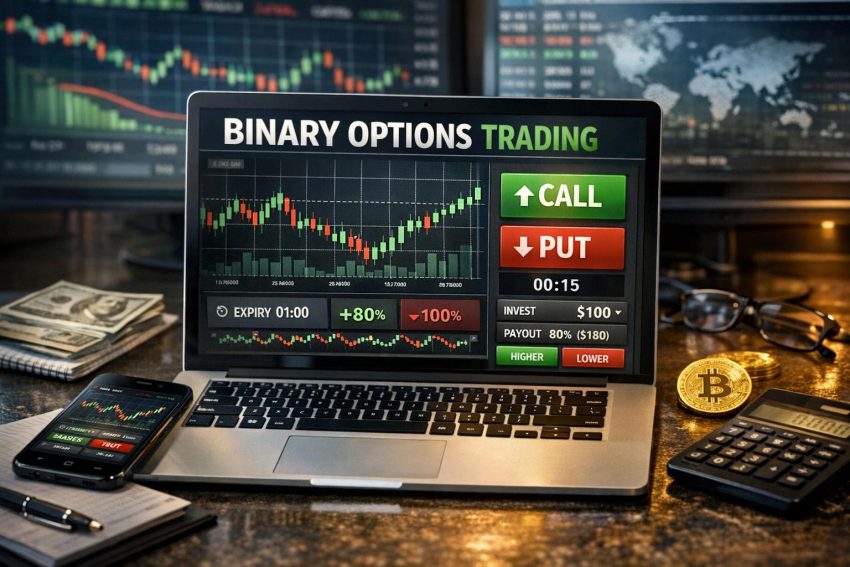
Binary options are one of those financial products that sound simple enough on paper: pick an asset, choose where you think the price will go, and decide whether you’re right by a specific time. The part people tend to gloss over is that the payoff is usually fixed and the loss is typically total. In other words, you’re not “investing” so much as you’re placing a time-bound bet on price direction or price behavior.
If you already know the basics, the useful next step is understanding how the contract structure shapes probabilities, risk, and long-term outcomes. That’s where most traders either get serious—or get quietly wrecked by math.
Understanding Binary Options Trading
Binary options trading is a way to speculate on the short-term price movement of an underlying asset. Unlike traditional investing—where you buy something and potentially hold it for years—binary options contracts are normally settled at a fixed expiration time.
The term “binary” describes the two possible outcomes at expiry:
- Correct prediction: you receive a predetermined payout.
- Incorrect prediction: you lose the stake you placed on the trade.
Most commonly, binary options are offered through online trading platforms. Expiration times can range from under a minute to several hours or even longer, depending on the provider and contract type.
Binary options are typically available on a wide set of assets such as stocks, indices, currencies, and commodities. Some platforms even include synthetic or derived instruments based on these underlying markets.
How Binary Options Contracts Work
Every binary options trade is built around a few core details. Once you understand these, the rest becomes less like “trading” and more like “calculating your odds and sitting still until expiry.”
The three core inputs
- Underlying asset: the market you’re trading (example: EUR/USD, an index, or a stock).
- Strike level: the price threshold you’re betting on (example: “above” or “below” a specific value).
- Expiration time: the moment the contract is settled.
Above/below example
Suppose an underlying stock is trading at $100. A trader buys a binary option choosing that the price will be above $100 in one hour. If the stock closes at $101 at expiry, the trade finishes in the money and the trader receives the agreed payout. If the stock closes at $99, the trade is out of the money and the stake is lost.
Payouts are usually fixed
Most contracts pay a fixed percentage of the stake when the trade is correct. You might see returns in the ballpark of 70%–90%, depending on volatility and the type of contract. Meaning: if you place $100 and the payout is 80%, your profit is $80 and your total account credit (depending on how the platform displays it) might show as $180 including the original $100.
If the prediction fails, the platform generally keeps the stake. This “all good, all bad” structure is not a detail—it’s the whole game.
Types of Binary Options
Not every binary option is a simple “above/below at expiry” bet. Providers often add variants that change what counts as a win. The payout can still be fixed, but the condition for settlement changes.
High/Low (call/put style)
This is the most common structure. You decide whether the asset price will be higher or lower than a set level at expiration. In practice, you’re making a prediction about direction over a defined time window.
One-touch options
In a one-touch contract, the question is not “what is the price at expiry?” but “does the price touch a certain level at any time before expiry?” If the price reaches the specified barrier even once, the contract settles as a win. If it never touches the level, it settles as a loss.
These trades reflect a different kind of probability. The market might end where you predicted—or it might not—so long as it touches the right barrier on the way.
Range or boundary options
Range contracts ask whether price stays inside (or breaks out of) a defined band. A typical setup might require the asset to remain between two levels until expiry. If it strays outside the boundaries at any time, the trade loses (or wins, depending on the exact contract wording).
Traders sometimes like these because they feel closer to “volatility control.” The reality is still the same: you’re betting on price behavior within a time limit.
Short-term / ultra-short contracts
Some platforms offer expiry times as short as 30 seconds (or even less). These contracts are meant for very fast decisions and often focus on quick price moves. The issue isn’t that they’re “bad” by definition; it’s that execution speed, spread, and random noise start to matter a lot.
When you compress time enough, even solid analysis can become irrelevant. At that point the trade is less about your chart reading skills and more about whether the market happens to do what you need before the clock runs out.
Pricing and Probability
Binary option pricing is directly connected to probability, because the payout must compensate for the likelihood of the predicted event.
If the platform believes an outcome is relatively likely, the payout might be lower. If it thinks the outcome is less likely, the payout might be higher. The exact pricing mechanics vary by provider and contract, but the probability relationship is the same idea you’d find in any payoff structure.
How “market odds” show up
In some exchange-like systems, you may see a “price” for a contract that moves between 0 and 100. Traders often interpret a value around 70 as implying roughly a 70% likelihood of success, though the mapping isn’t always perfectly literal.
Still, the core lesson holds: the contract price and the payout are telling you what the provider (or market) thinks is likely to happen.
The break-even win rate math
The fixed payout and the fixed loss create a straightforward requirement for profitability. Because when you lose you typically lose 100% of the stake, you need a win rate high enough to cover losses and still end positive.
Here’s a simplified way to think about it:
- Assume payout is P (as a fraction of the stake). Example: 0.8 payout means +80% profit on a win.
- You break even if: Win rate × P = (1 − win rate) × 1.
Solving gives: Win rate = 1 / (1 + P) (for this simplified case).
Example: if payout is 80% (P = 0.8), then win rate needed ≈ 1 / (1.8) = 55.6%. If payout is 70%, win rate needed ≈ 1 / 1.7 = 58.8%. That’s why traders can be “right often” and still not make money—the win rate requirement can quietly creep upward when payouts are lower.
Volatility changes the game
Market volatility influences binary option pricing because it changes the probability distribution of where price might be at expiry (or whether a barrier is touched).
On calmer markets, directional moves might be smaller, so a one-touch barrier might be less likely and the payout might be priced to reflect that. During news events, volatility jumps, and the “chance of touching” or “chance of finishing above/below” changes fast—often faster than retail traders can react.
Trading Platforms and Market Access
Most binary options are executed through online platforms. The mechanics of order placement are simpler than in many traditional markets, but the platform relationship matters.
Over-the-counter (OTC) vs regulated settings
Some providers operate in an OTC model, meaning the platform sets terms and acts as the counterparty. In that case, prices and contract availability are determined by the provider’s internal policies.
In more regulated or exchange-like environments, contract trading might be priced by market participants, governed by exchange rules. In both cases, traders still need to pay attention, because “regulated” is not a synonym for “risk-free.” It’s more like “rules exist, at least on paper.”
Platform features that actually matter
Platforms often advertise charting, indicators, and educational tools. Some of that is genuinely useful for execution and recordkeeping, but the big practical concerns are:
- Execution and order confirmation: you want to know the trade is placed at the intended time and price condition.
- Expiration settlement rules: some contracts settle based on bid/ask, others on last traded price, others on a specific reference pricing method.
- Account funding and withdrawals: payment processing rules can affect your ability to retrieve funds.
People don’t usually regret learning about these pieces beforehand. They regret it after.
Mobile trading reality check
Many traders use mobile apps for convenience. It’s fine, but short expiration contracts can make app latency and connectivity issues matter. If your connection stutters during a 30-second window, the market won’t get the memo.
Regulatory Considerations
Binary options have faced heavy scrutiny for years. Several regulators concluded that the product structure, combined with the way some brokers marketed it, created an environment with elevated risk to retail customers.
Why regulators stepped in
Regulatory concerns often revolve around:
- Transparency: whether traders clearly see how pricing, payout, and settlement work.
- Conflicts of interest in OTC models, where the provider may influence pricing.
- Marketing practices, especially claims that imply guaranteed or easy profits.
What to check in your country
Before using any platform, you should verify:
- Whether binary options retail access is allowed in your jurisdiction
- Whether the platform is authorized by the relevant oversight body
- What protections exist if there’s a dispute
Even with regulation, remember that binary options are still a high-risk product. Oversight can reduce certain operational abuses, but it won’t magically fix the math requirement for a high win rate.
Risk Characteristics
Binary options are often described as high-risk for a reason: the payoff structure is asymmetric in a way that punishes small prediction errors over time.
Limited upside (because the payout is capped)
The maximum profit is predetermined at the start of the trade. Even if price moves far in your favor, the profit doesn’t expand beyond the agreed payout percentage.
This matters because it changes how you judge opportunities. Traditional traders sometimes think in terms of “I might be underestimating how far it could go.” With binary options, the contract doesn’t care. It cares only whether a condition is met at settlement.
Total loss potential (because losing usually means losing everything you staked)
If you get the condition wrong at expiry, the stake is typically lost. There’s usually no partial recovery. That structure turns each trade into a high-impact event.
Short time frames increase noise exposure
Short expirations mean you’re exposed to microstructure noise: spread changes, sudden ticks, and short-lived volatility bursts that may not reflect the bigger picture.
When timescales shrink, “data you can analyze” becomes less important than “data that happens fast enough.”
Statistical challenges are baked in
Because payouts are usually less than 100% of the stake, the break-even win rate must be above 50%.
So even a trader who wins 50% of trades will likely lose money after accounting for the lower payout. And many traders—especially those testing strategies—tend to underestimate how quickly random variation can trick them in the short term.
Leverage-by-behavior
Binary options are not always “leveraged” in the formal margin sense for every provider and contract, but many traders behave as if they are. When stakes are large relative to the account, the statistical outcome can resemble leverage: a short run of losses can hit hard, and a short run of wins can encourage bigger bets. That cycle is where accounts tend to break.
Common Trading Approaches
Binary options traders often lean on methods that can make decisions on short time frames. Some rely on technical analysis. Others incorporate news events. A few attempt quant-style probability checks. The shared theme is decision-making under time pressure.
Technical analysis for short-term direction
Very common tools include moving averages, support and resistance levels, trend lines, and oscillators. The basic logic is that price behavior repeats enough times to be useful, even if it’s not “guaranteed.”
For binary options, traders often try to identify moments where the probability of a move above/below the strike is higher. The problem isn’t that technical analysis is useless; it’s that the time window can be too short for your signals to play out before settlement.
News and event timing (especially in FX)
Certain markets, particularly currency pairs, react sharply around scheduled announcements like employment reports or central bank decisions. Binary options contracts can expire during or immediately after these events, which means volatility can spike suddenly.
Some traders try to trade the expected direction. Others focus on the volatility itself. Either way, you’re in the “fast decision” category: spreads can widen, price can jump, and the market can overshoot before settling back.
Risk management: position sizing isn’t magic, but it helps
Risk management in binary options usually means limiting stake size relative to account balance. For example, risking a small fraction per trade can reduce the chance that a short losing streak wipes out the account.
This doesn’t improve your probability of winning. It improves your ability to survive long enough to test whether your edge exists.
A common failure mode is treating a handful of trades as evidence of skill. For binary options, you typically need a much larger sample size before you can say anything meaningful about performance, because variance is brutal when wins and losses are all-or-nothing.
Comparison with Traditional Options
Binary options get compared to traditional (vanilla) options, but they behave differently because the payoff structure is different.
What traditional option holders actually get
With a standard call or put option, the holder has the right, not an obligation, to buy or sell an asset at a strike price at or before expiry. The option’s value can change over time with volatility, time to expiry, and how far price is from the strike.
That means even if an option later expires out of the money, it may still have had value earlier. You can also exit early, roll positions, or manage with hedging.
Binary options settle on a condition
Binary options typically don’t scale with how far price moves beyond the strike. At expiry, either:
- the condition is met and you receive the fixed payout, or
- the condition is not met and you lose the stake.
This makes the product straightforward to understand, but it also removes some of the flexibility that traditional options provide. The trade is basically “yes/no” at the end time.
It’s like ordering a meal and receiving either the full dish or nothing, even if you ate half the time. Not the way anyone wanted dinner to work, but the menu is the menu.
Market Perception and Criticism
Binary options have drawn criticism from regulators, trading educators, and financial professionals. The criticism isn’t just about price movements—it’s about how the contracts are structured and sold to retail users.
Wagering vs investing perception
Because the payoff is fixed and the time frame is often short, critics argue the setup resembles wagering rather than investing. That critique is partly about the contract form and partly about the marketing style used by some providers historically.
Misleading promotional claims
Some segments of the industry have been associated with aggressive promotions promising high returns. Even when those claims are “based on a trading strategy,” they ignore the statistical reality: you can believe a strategy is good while still losing because outcomes vary wildly early on.
Where enforcement improves practice
Some jurisdictions took enforcement actions, tightening disclosure and restricting marketing. That helped reduce the worst behaviors, but it didn’t erase the underlying risk of the product itself.
Suitability and Investor Considerations
Binary options are usually categorized as speculative. If your goal is long-term growth, stable income, or diversified portfolio exposure, binary options are usually a poor fit.
Assess financial capacity
Money used for binary options should be money you can lose without affecting essentials like rent, bills, or debt payments. In practice, binary options are not a small side hobby if stakes get too big. Accounts can fall fast because losses are often full-stake.
Understand the probability requirements
Many people miss that profitability depends on both:
- your win rate, and
- the payout relative to losses.
A win rate that seems respectable might still not be enough if payout percentages are low. The break-even win rate depends on that payout.
Check regulatory status and provider behavior
Look at whether the platform is regulated, what the settlement rules are, and how withdrawals are handled. If a platform’s terms are fuzzy or change without warning, that’s a warning sign, not a negotiating point.
Match risk tolerance to the contract design
Short time frames mean your account value can swing quickly. If that kind of volatility keeps you from making rational decisions, binary options can become a behavioral problem, not a technical one.
Put differently: can you follow your plan when the trade results don’t cooperate? If the answer is “not really,” the market will happily prove your theory wrong.
Practical Checklist for Before You Trade
You don’t need a degree in derivatives to use binary options. But you do need to be clear on contract terms, settlement methodology, and practical execution details.
Know what settles at expiry
Confirm whether settlement uses a reference price, bid/ask, or another method. This matters when spreads widen or when price jumps between ticks. Two traders can both “see the chart” but still end up with different outcomes if they’re relying on different pricing conventions.
Track your real results, not just wins
Binary options performance is easiest to misread. A few wins don’t prove an edge, and a few losses don’t prove the strategy is bad. You want to track:
- the payout and stake per trade
- the win/loss outcomes
- the sample size before judging
Watch transaction realities
Even when a contract payout looks attractive, spreads and execution timing can erode returns, especially on very short expiries. If your fills consistently happen at worse prices than expected, your probability assumptions are off.
Conclusion
Binary options trading centers on predicting whether a price condition is met by a specific expiration time. The contract structure typically features fixed payouts and a total-loss risk when the prediction is wrong. That simplicity is why the product is easy to understand—and why it’s also unforgiving when you’re even slightly off on probability.
Regulation varies across jurisdictions. Some environments have placed strict limits or banned retail access, largely due to concerns about transparency, conflicts of interest, and marketing practices. If you’re considering participation, you should treat regulatory status and provider terms as fundamental due diligence, not fine print reading cosplay.
Approach binary options with a clear view of the math: you generally need a win rate above the break-even threshold determined by payout percentages. Combine that with disciplined risk management and a realistic plan for how many trades you need to evaluate whether your strategy has any edge. If you skip those parts, the market will still trade—just not in your favor.