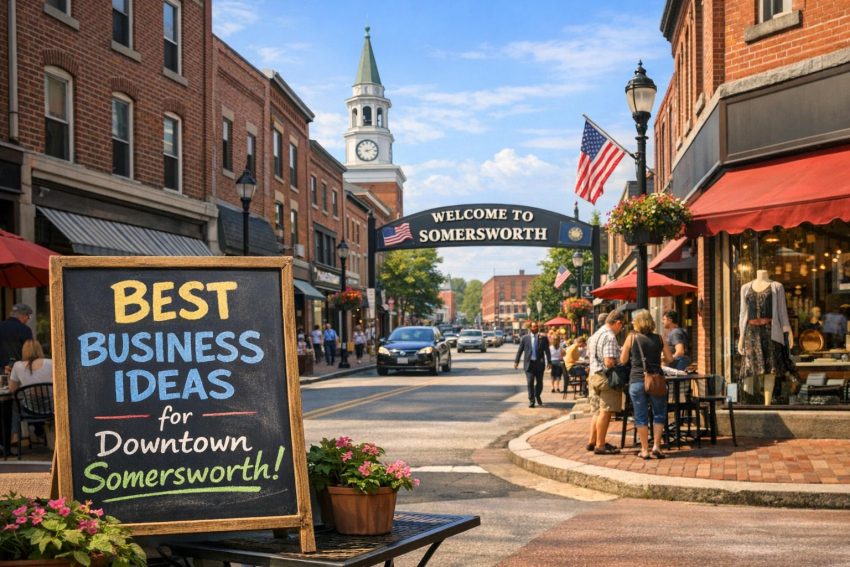
Downtown Somersworth sits in a fairly useful spot: southeastern New Hampshire, along the Salmon Falls River, and not too far from Dover and Portsmouth. Over the last decade it has also shifted from “mostly mill town” to something closer to mixed-use downtown living—renovated buildings, more residential units above shops, and a steady push toward better streetscape and local planning.
That combination matters for business ideas. If you’re choosing a concept from scratch (or relocating from somewhere else), you’re not just picking a product or service—you’re picking the type of foot traffic you want, the customers you can realistically reach, and the business model that fits the local buying behavior. This article lays out practical options that tend to work in downtown settings like Somersworth, with a focus on execution realities: overhead, location fit, demand sources, and operating patterns.
Start with the downtown demand pattern (before you pick a business)
Most downtown districts have a similar rhythm, even if the industries differ. You’ll typically see:
- Daytime demand from people who live nearby, work nearby, or visit local offices.
- After-work demand from commuters and people coming in for dinner, errands, or quick get-togethers.
- Weekend demand from families, visitors from surrounding towns, and residents doing “local errands because it’s convenient.”
In Somersworth specifically, the revitalization momentum adds another layer: more residents moving into or near the downtown core, plus easier access to regional trips (Dover, Portsmouth, and Maine border traffic). Your business idea should match at least one of those demand sources instead of hoping “people will just come.” They won’t—at least not consistently.
Food and Beverage: the most proven entry point
The food and beverage sector remains the most reliable way to earn revenue in a downtown environment. Not because it’s easy (it isn’t) but because customers already expect it. People plan meals, they treat dinner out as a routine, and they’ll try a hometown place if the quality and price feel fair.
Casual dining with a practical hook
A casual dining restaurant with a locally sourced menu can work well when it’s built around consistency rather than novelty. Downtown customers usually forgive a restaurant for being busy; they don’t forgive it for being unpredictable. If the menu changes every week, service speed drops, and portions don’t match the photos, repeat visits fall apart.
A useful approach in Somersworth is to design the concept around what people will order repeatedly. Think comfort-forward mains, lunch options for daytime visitors, and a few seasonal specials. Also, consider the cross-border angle: Maine visitors and nearby Dover residents can fill gaps when the local population isn’t enough.
Specialty coffee and light breakfast
An independent coffee shop with light breakfast is a common winner in walkable downtowns because it fits two customer roles: “I need something during the day” and “I want to hang out for a bit.” Somersworth’s commuter pattern supports weekday morning traffic, particularly if the store opens early and serves reliably.
To stay competitive, avoid the trap of trying to be everything at once. Better: pick a few strong items (coffee drinks, a short breakfast menu, and a rotating pastry or two), then execute them well. If you offer weekend seating, keep it comfortable and clean—people notice. They might not say it out loud, but they will judge you with their feet.
Craft brewing and taproom models
A craft brewery or taproom can make sense in Somersworth, especially if you take advantage of renovated mill buildings that fit the vibe while still supporting operations. But the business model should be realistic for the space you can lease rather than the dream setup you saw online.
A smaller footprint can support limited-barrel brewing plus a taproom. You can also reduce startup cost by partnering with food trucks or nearby restaurants for food service. That lowers build-out risk. Many successful taprooms rely more on the beverage experience and community programming than on being a full restaurant.
If you go this route, pay attention to logistics: beer tapping schedules, waste disposal, local licensing requirements, and event timing. Downtown foot traffic loves events; your back-of-house has to love them too.
Specialty Retail: niche over noise
Retail in smaller downtowns works best when you avoid direct competition with national chains on identical products. Somersworth doesn’t have the retail density of a major city, which creates room for smaller shops—if they offer something local customers can’t easily get nearby.
Specialty grocery or international market
A specialty grocery or international market can succeed by serving an evolving local demographic and by offering ingredient variety. People often travel longer distances for specific brands or foods, especially when they’re cooking at home regularly. If you stock products that are consistently available—rather than a one-off selection—repeat demand rises.
Pricing also matters. Specialty items can’t all be luxury-priced. A small market should also include “regular baseline items” (bread, staples, common produce categories where feasible) so customers aren’t forced to do two grocery runs every week.
Independent bookstore with programming
An independent bookstore combined with community programming can outperform a bookstore that only sells books. Events create reasons to visit beyond browsing. Typical programming includes author talks, book clubs, kids reading hours, writing workshops, and basic skill sessions.
Somersworth’s location near schools and regional communities supports this model. The bookstore becomes a meeting point, not just a retail shelf. If you sell stationery, local history books, or small community-brand items, you also create extra margin without adding major complexity.
Home décor and local artisan goods
A home décor and local artisan goods store fits naturally into downtown revitalizations. Visitors like walking into places that feel “rooted here.” Artists and makers often seek affordable storefronts and simple visibility. If you curate local products—candles, ceramics, textiles, small furniture pieces—you attract residents who want regionally made goods without paying city-level prices.
For revenue stability, make sure the store hours match customer habits. If you close too early or too often, you’ll lose the casual browsing crowd. Online sales also help, especially for smaller items that ship easily.
Professional and business services: steady demand, lower hype
Services tend to be quieter businesses than cafés or retail, but they can be dependable because people need them regularly. Downtown Somersworth’s growth in residential units and proximity to offices supports a set of practical service categories.
Co-working and flexible office space
A co-working space designed for remote workers and small startups fits a region where some professionals commute and many others work hybrid or remote. The space can offer daily passes, membership plans, private offices, and meeting rooms.
The simplest way to keep it financially sensible is to avoid overbuilding. For example, you don’t need a hundred desks if you can occupy 30-60 consistently. Common add-ons that customers value include high-speed internet, quiet areas, phone booths, and reliable access hours.
Also consider partnerships with local businesses that already serve the community. A co-working space becomes easier to sell when it participates in events, workshops, or business meetups instead of waiting for inquiries.
Accounting, tax prep, bookkeeping
A small accounting firm can work well in downtown settings because visibility and client access matter. People prefer meeting a professional in a place that feels legitimate and convenient, especially when taxes and paperwork are involved. Being near municipal offices and legal services supports foot traffic.
Tax prep season creates spikes, so it helps to offer bookkeeping or monthly accounting support during the rest of the year. You can also serve local small businesses with payroll setup, sales tax organization (where applicable), and basic financial reporting.
Legal offices with a local focus
Legal practices specializing in real estate, small business formation, and some family law categories are often stable because downtown areas include more property transactions and local business filings. If you open a legal office, your marketing should emphasize process clarity: what clients should bring, what timelines look like, and what the fees cover.
Downtown clients value predictability. “We’ll figure it out later” feels cheap and costs you goodwill. Clarity is an asset.
Physical therapy and related health services
A physical therapy clinic, counseling practice, or occupational therapy office can thrive when it’s positioned where clients can reach it easily and when the staff schedules are consistent. Appointment-based traffic stabilizes revenue compared to walk-in models.
The space requirements depend on the service. But downtown locations often work for smaller clinic setups, especially when you align the layout with privacy needs. Partnering with nearby healthcare providers also helps referral flow.
Health, wellness, and fitness
Wellness businesses have grown across the country, and Somersworth is no exception. The downtown fit is strongest when the concept supports convenience: close parking or walkability, consistent scheduling, and a service model that doesn’t depend on a large dedicated campus.
Yoga and Pilates studios
A yoga or Pilates studio can operate efficiently in second-floor spaces or renovated industrial units if you can manage acoustics, ventilation, and storage. Classes create predictable attendance cycles, and customers often buy packages that spread income across time.
To stand out, consider a specific schedule pattern. For example, offer early morning weekday classes for people who have busy days, plus evening sessions for those who work standard hours. It’s less about branding and more about matching real schedules.
Multi-service wellness centers
A multi-service wellness center (massage therapy, nutrition counseling, wellness coaching) can diversify income. The logic is simple: if one practitioner’s schedule tightens, another may have openings, and clients often cross-refer within the center.
Be careful with space planning. Multiple services can feel busy, but you’ll need privacy, appropriate waiting areas, and clear appointment processes. A messy front desk can kill trust quickly.
Senior-focused fitness and rehabilitation
Somersworth and surrounding towns include older adults who often need lower-impact exercise. A senior-focused fitness and rehabilitation center can address a real gap if you design programs around mobility, balance, and safe movement.
Accessibility matters: entrances, door widths, bathroom layout, and appointment flow. Partnering with local healthcare providers also increases legitimacy for clients who prefer guidance from trusted sources.
Child and family business ideas
Families shape demand in a different way than adults. They need convenience, predictable schedules, and safe environments. Downtown Somersworth has opportunities here, especially when the business model accounts for parents commuting for work in the broader Seacoast area.
Licensed childcare near downtown
A licensed childcare center located in or near downtown addresses consistent demand. Many parents need extended hours due to work locations and commuting time. Childcare also creates recurring customer relationships—once families enroll, they tend to stay if the center is organized and responsive.
This category involves regulatory requirements, safety standards, staffing credentials, and capital costs. It’s not a “small shop” idea. If you pursue it, research zoning, find a space that fits licensing needs, and plan for long-term staffing retention rather than short-term hiring cycles.
Tutoring and STEM learning labs
Tutoring centers or STEM learning labs can work well in downtown locations because parents prefer convenient drop-off and reliable schedules. Programs focused on mathematics, coding, robotics, or test preparation often see long-term interest from families who want structured academic support.
A simple but effective approach is to offer small group sessions. It makes bookings easier and improves learning outcomes compared with purely one-on-one or purely lecture-driven models.
Indoor family entertainment (evaluate it carefully)
An indoor family entertainment venue—like a small play café—can complement dining and create weekday daytime traffic. Still, this category has extra requirements: insurance, safety systems, staff training, and sometimes specialized facility rules.
Before signing a long lease, verify zoning and confirm how noise will be managed. Also check whether the space supports the ventilation and cleaning schedule you’d need for high turnover foot traffic.
Creative and cultural businesses
Downtown Somersworth’s mill architecture can add character to arts and cultural ideas. These businesses often succeed when they mix public programming with practical revenue streams like rentals or memberships.
Art gallery plus studio rentals
An art gallery combined with studio rental space can activate underused square footage. Studio rentals provide ongoing income, while gallery sales add variability. If you structure contracts clearly—what utilities are included, how long leases run, and what rules exist for common areas—you reduce friction.
Gallery programming also helps: opening evenings, small exhibitions, seasonal themes, and artist talks. Many customers become regular visitors when they feel something is happening on a consistent schedule rather than random “maybe we’ll host something.”
Community performance spaces
A community performance venue that hosts small concerts, theater productions, and lectures can increase nighttime activity. The risk is that ticket sales alone may not cover fixed costs.
A workable model blends ticketed events with rentals for private gatherings, workshops, and community meetings. Think of it as a flexible venue first, entertainment unit second.
Podcast and digital media studio
A podcast and digital media studio serving regional entrepreneurs and organizations can fit in compact downtown suites. Most costs come from soundproofing, microphone/recording equipment, and a comfortable setup for interviews. When you have the gear, you can package services: single-session recordings, editing add-ons, and recurring subscription-style content support.
This business often sells better with straightforward packages and sample recordings. If your site or brochures show “here’s what a finished episode sounds like,” you’ll attract clients with less hesitation.
Property development and mixed-use investment
Not everyone who invests in downtown does it with a storefront business. Some investors win through mixed-use redevelopment projects. In areas like Somersworth, the logic is straightforward: renovate and modernize upper floors for residential use while keeping commercial energy at street level. More residents typically mean more consistent demand for nearby shops and services.
Adaptive reuse of industrial buildings
Somersworth has the architectural stock for live-work units and adaptive reuse. Converting industrial space into livable layouts can be challenging, but it aligns with the area’s existing footprint. Developers should work with municipal planning boards to understand incentives or tax credits related to historic preservation or economic development.
Even if a project is complex, the payoff is long-term occupancy stability. Mixed-use properties also reduce vacancy risk because residential and commercial spaces respond differently to local economic cycles.
Smaller commercial unit subdivision
Smaller investors can also subdivide large commercial spaces into smaller lease units for startups. When downtown spaces are oversized, new businesses struggle to afford rent while building revenue. Flexibility in lease terms and reasonable tenant improvement expectations can reduce vacancy and attract more diverse operators.
Don’t ignore practical details: shared entrances, signage rules, utility separation, and common area maintenance costs. Those “boring” issues become expensive fast if they’re not planned upfront.
Hospitality and short-term accommodation
Somersworth isn’t the major coastal tourist hub. But it’s close enough to capture spillover demand. People traveling between Dover and Maine coastal stops often look for places that are priced more reasonably than seaside hotels.
Boutique inn or extended stay lodging
A boutique inn or extended-stay facility can work if you position it around convenience and affordability. Corporate travelers also show up when regional industries require temporary housing.
One practical advantage is location to restaurants and daily services. A property within walking distance can reduce dependency on driving, which appeals to travelers who don’t want extra hassle. Still, you must check zoning and parking requirements, because those rules define how you can operate.
Parking and operations are not “afterthought” issues
Short-term lodging lives or dies by logistics: how guests arrive, where cars go, how quickly maintenance is handled, and how you manage peak check-in times. Before committing to a hospitality concept, build an operational plan around staffing and daily maintenance rather than just room design.
Technology and light manufacturing
Somersworth’s manufacturing heritage isn’t just history—it’s a hiring and skills foundation. That matters when you consider modern light manufacturing workshops or technical services that need space and practical infrastructure.
Light manufacturing for niche products
A light manufacturing workshop producing specialty goods—custom cabinetry, metal fabrication, or niche consumer products—can fit renovated industrial buildings. This works best when you can sell beyond the immediate downtown catchment area. In other words, you’re selling to regional demand, not only to people who walk by.
To make it viable, the product should have either (a) a clear niche customer base, (b) strong repeat orders, or (c) high perceived value that supports labor and materials costs.
Computer and phone repair
A computer and mobile device repair shop remains a dependable model because people constantly need hardware maintenance. Even when technology changes, the demand for repairs and replacements doesn’t disappear. You can also expand into business IT support contracts.
That’s important: business clients provide steadier volume than consumer walk-ins during slow weeks. Offering managed services—basic device management, backups, software troubleshooting—creates a recurring revenue stream.
Prototyping and 3D printing services
Prototype development and 3D printing services can attract regional designers, inventors, and small product teams. The value is speed and local access. If someone can test a physical prototype locally rather than waiting for shipping timelines, they’ll pay for convenience.
This model also tends to scale with partnerships. Working with makerspaces, small engineering firms, or local entrepreneurs gives you recurring project flow. Pricing should clearly separate “design help” from “print job” so customers understand what they’re paying for.
Environmental and sustainability-focused ventures
Environmental preferences show up in buying habits, but they don’t have to turn into a costume. Sustainability businesses succeed when they save customers money, time, or hassle—even if the brand talking points stay simple.
Refillable household goods
A refillable household goods store could work in downtown areas where customers prefer convenience and consistent product availability. Bulk cleaning supplies, low-waste products, and refills create repeat visits. Membership-based models can add stability if pricing and refill procedures are clear.
Operationally, you’ll need reliable suppliers, accurate refill systems, and strict cleaning protocols. Customers won’t tolerate sloppy labeling or containers that look questionable.
Home energy audits and efficiency upgrades
A home energy audit company headquartered downtown could serve Strafford County more broadly. Rising energy costs (and the general desire to stop money from leaking out of buildings) make energy efficiency a steady topic.
In many cases, audits are a gateway to follow-on work: recommendations, contractor referral, or direct sales of upgrades. If you can show measurable outcomes—estimated savings, before-and-after improvements—you’ll build credibility with homeowners.
Key considerations when you pick a site and write your business plan
There are no magic business ideas—only ideas that match local conditions and your own ability to execute them. Before you sign a lease or buy equipment, treat these issues like homework you can’t skip.
Foot traffic and parking realities
If you’re opening a storefront business, you need to understand who walks by and who drives in. Downtown Somersworth foot traffic will not behave like a major retail corridor. It’s more seasonal, more time-of-day dependent, and heavily influenced by events, office schedules, and nearby residential occupancy.
Also check parking behavior. If your business depends on cars and you don’t have reliable parking access, sales drop quietly. People still discover you, but they decide it’s not worth the hassle.
Lease terms and overhead control
Lease rates and building expenses can make good concepts fail. A tenant improvement buildout—signage, plumbing, wiring, HVAC—can be more expensive than expected, especially in older mill buildings. Ask for accurate estimates and confirm what the landlord provides versus what you must supply.
Start with a conservative rent and expense model. If you need help: plan for a few months of slower ramp-up. Downtown openings sometimes take longer than owners expect because awareness takes time.
Zoning, licensing, and build constraints
Downtown leases quickly become “real projects” once licensing begins. Food businesses face health department requirements. Childcare has safety and staffing rules. Lodging has occupancy and fire compliance. Light manufacturing has ventilation and waste regulations.
Check these before you fall in love with the space. Otherwise you’ll end up fine-tuning your concept around restrictions. That adjustment is doable, but it’s easier when you plan early rather than late.
Local partnerships and community visibility
Restaurants, service providers, and retail shops all benefit from being visible in community routines. That can mean chamber involvement, seasonal events, school partnerships, or cross-promotions with neighboring businesses. This isn’t charity—it’s direct customer acquisition.
For example, a specialty market can work with local cafés and restaurants for ingredient sampling. A co-working space can host monthly pitch nights for freelancers. A fitness studio can partner with a senior center for introductory classes. The businesses that win tend to act like part of the neighborhood instead of a separate “pop-up” operation.
Where each business idea fits best in Downtown Somersworth
Because downtown has different street-level realities from one block to another, your best location depends on what kind of customer you pull.
Street-front pedestrian traffic
Food and coffee, quick retail, and storefront service counters usually do best here. People need visibility and easy entry.
Second-floor and quieter spaces
Studios, therapy offices, co-working rooms, and workshops fit where noise and foot traffic aren’t the main driver. If you operate classes or appointments, customers will find you—but only if the building offers access that feels straightforward.
Industrial building conversions
Light manufacturing, prototyping services, and some breweries work better where ceiling height, ventilation, and structural capacity are suitable. Downtown repositioning often makes these spaces available, but you still need an engineering reality check before assuming the space can handle your workflow.
Example fit scenarios (how the pieces line up)
Here are a few realistic “fit scenarios” based on the common demand patterns described earlier. These aren’t one-size-fits-all, but they show how the math tends to work.
Scenario: a coffee shop next to municipal and professional offices
A specialty coffee and light breakfast café with early access supports weekday demand. It also captures commuters who want a quick stop before work and professionals who meet for a morning meeting. Weekend seating supports social use.
Scenario: a small co-working space with meeting rooms
Remote workers and small startups often need reliable internet and a quiet space. A downtown co-working model works well when membership prices are simple, access hours are stable, and the space supports small collaboration with meeting rooms.
Scenario: an art gallery with studio rentals inside a renovated mill building
Studio rentals stabilize income while gallery events drive visits. Artists regularly need a place to work, and customers enjoy consistent programming. This concept also pairs well with seasonal downtown event calendars.
Scenario: repair and prototyping services for regional makers and businesses
Computer repair benefits from constant demand and local convenience. 3D printing and prototyping depend on broader regional customers, but downtown proximity can still help because local entrepreneurs prefer meeting a service provider in person when timelines matter.
Conclusion
Downtown Somersworth offers more than “a decent place to try something.” It has real structural advantages: a growing residential presence near the core, proximity to Dover and Portsmouth, an industrial architecture base that supports adaptive reuse, and ongoing community planning that keeps remodeling and redevelopment moving.
Food and beverage concepts, specialty retail with a real niche, steady professional services, and wellness businesses generally align with the local demand rhythm. Creative enterprises and light manufacturing add variety and can thrive when they serve regional customers or use rentals and programming to stabilize income. Meanwhile, higher-capital redevelopment projects can build the density that makes storefront businesses work.
The practical rule is simple: pick a concept that matches measurable demand patterns, confirm that the space and regulations fit your operations, control overhead from day one, and participate consistently in what’s already happening downtown. Do that, and you’re not just opening a business—you’re building something that can last in Somersworth.