what binary options in Somersworth actually means
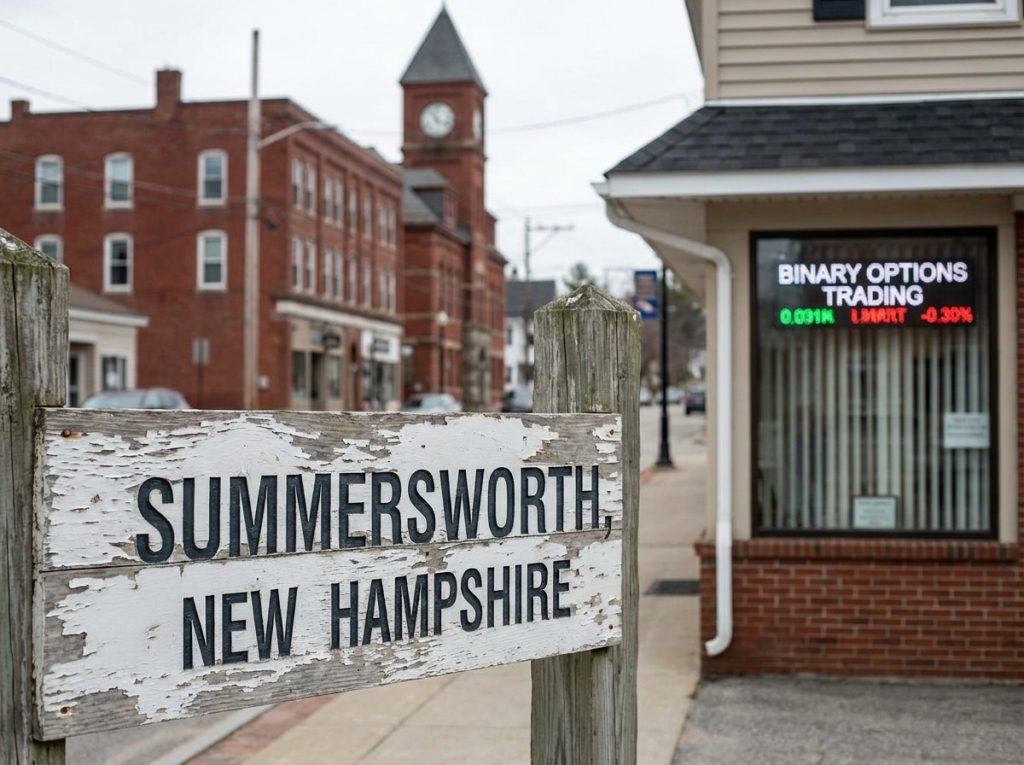
Binary options in Somersworth is mostly a question of access and legality, not a question of local market opportunity. A trader sitting in Somersworth is not trading a New Hampshire binary options market. He is either accessing a U.S. regulated exchange product from a New Hampshire address, or he is sending money to an offshore platform that may be lightly supervised, badly supervised, or not supervised in any meaningful sense at all. That distinction is the whole subject. Everything else is detail. The town itself does not change the product, the payout structure or the risk. Somersworth’s latest official estimate is 12,218 residents, which is enough to remind us that most people approaching this market locally are retail traders, not institutional desks with legal teams and exchange memberships.
That matters because binary options are one of those products that look simple right up until the operational reality arrives. The contract asks a yes or no question. Will a market finish above a level or not. Will an event occur or not. That clean framing is what attracts retail traders. It feels easier than trading a futures contract or managing an open forex position. The simplicity is real at the contract level. The danger is that the economic structure is usually less forgiving than beginners expect, and the venue risk is often worse than in more conventional markets. The U.S. government has been warning about binary options fraud for years, and those warnings still matter because the product remains a favorite vehicle for retail scams and misleading platforms. See the joint SEC and CFTC investor alert and the Investor.gov explanation of “all or nothing” schemes.
So the useful version of this article is not “how to get rich with binary options from Somersworth.” That would be nonsense. The useful version is to explain what is actually legal, what is actually tradable from New Hampshire, how the payout math works, and why most retail traders are better served by caution than by enthusiasm.
The legal and regulatory framework in the United States
For a trader in Somersworth, binary options are regulated at the federal level, not by the town and not by some special New Hampshire trading code. The main federal reference points are the Commodity Futures Trading Commission and, depending on the product structure, the Securities and Exchange Commission. The key point is that legal access in the United States is tied to regulated venues. Nadex states directly that event contracts are legal and available to trade in the U.S. only on a CFTC regulated United States exchange, and that Nadex itself is a CFTC designated contract market and derivatives clearing organization. Whatever one thinks of Nadex as a venue, that statement captures the broad legal distinction retail traders need to understand.
This distinction matters because most of the ugly stories around binary options did not come from transparent exchange traded contracts. They came from offshore platforms that marketed binary options aggressively, took deposits easily, and then allegedly refused withdrawals, manipulated software, or generated other forms of fraud. The long standing SEC and CFTC investor alert on binary options and fraud warns about exactly those patterns, including refusal to credit customer accounts, reimbursement problems, identity theft and software manipulation to create losing trades. The fact that the alert is older does not make it stale. It still describes the practical risk landscape unusually well.
There is also a narrower point that can confuse traders. Binary style products do exist on regulated U.S. venues in more than one form. Recent SEC notices show exchange rule changes involving binary options on certain listed index options markets, which means the label “binary options” is not automatically synonymous with illegal offshore websites. But that does not rescue the retail trader from the central problem. The product may be lawful on a properly regulated exchange, yet still be a poor fit for most retail capital because the payoff profile is harsh and the edge requirement is high. Lawful and sensible are not identical words.
The federal regulatory conversation around event contracts has also stayed active in 2026. The CFTC issued an advance notice of proposed rulemaking in March 2026 regarding prediction markets and event contract derivatives, asking for comment on which contract types may be prohibited as contrary to the public interest under the Commodity Exchange Act. That does not mean all event contracts are suddenly unavailable. It does mean the regulator is paying close attention to contract design, venue obligations and the public interest boundaries around these products. Retail traders in Somersworth should read that not as a technical footnote, but as a clue that this is a sensitive part of derivatives regulation rather than some casual app based side game.
So the legal answer is plain. A person in Somersworth can, in principle, access certain U.S. regulated binary or event style contracts through lawful venues. What he should not do is assume that any website offering “binary options” to a U.S. resident is legal, safe or worth touching.
How binary options work, and why the structure is harsher than it looks
A binary option is an all or nothing contract. At expiry, one of two things happens. The contract settles in the money and pays a fixed amount, or it settles out of the money and pays nothing, aside from whatever secondary market value may have existed before expiration if the contract was tradeable on an exchange. The Investor.gov explanation describes this directly. That surface simplicity is what makes the product attractive. It seems easier than managing stop losses, scaling out of positions, or deciding whether a trend still has room to run.
The problem is that a fixed payout creates a very unforgiving math problem. In many retail binary setups, the trader risks a full amount to earn something less than that full amount. Even where exchange pricing is cleaner than classic offshore payout structures, the core issue remains: a trader does not just need to be directionally right. He needs to be right often enough, with timing precise enough, to overcome the product’s built in economics and transaction friction. Small mistakes matter more than traders expect. A market can move broadly in the anticipated direction and the trade can still lose because the contract expires a little too early or the level chosen was slightly wrong. The simplicity of the yes or no framing hides the strictness of the timing requirement.
This is where many retail traders get trapped by presentation. Binary options feel controlled because the maximum loss is known in advance. That part is true. But knowing the maximum loss does not mean the expected value is favorable. A slot machine also limits the size of one spin. That does not make it a compelling investment vehicle. The hard question is whether the trader has an edge after pricing, fees, timing and execution are included. In most retail use cases, that answer is weaker than the sales language suggests. The product is compact, not generous.
So before the Somersworth angle even enters the picture, the product itself deserves skepticism. Binary options are simple to describe, difficult to beat consistently and unusually vulnerable to being wrapped in misleading marketing. Those are not ideal traits for the average retail trader.
You can learn more about Binary Options and how to trade Binary Options safely by visiting BinaryOptions.net. Binaryoptions.net is one of the oldest and most reputable websites about binary options. They take a neutral stance to binary options and try to help you reduce the risk you expose yourself to, regardless of whether you try to trade in binary options or not.
What the Somersworth angle changes, and what it does not
Somersworth changes almost nothing about binary options as a market product. The contract does not become safer because the trader is in New Hampshire. The payout profile does not improve because the desk is in Strafford County. The local angle is mainly practical. It affects time zone, work routine, tax context and the likely retail profile of the trader. Somersworth is in Eastern Time, which aligns comfortably with U.S. market hours and regulated exchange access. For event style products trading during U.S. sessions, that is at least convenient. Convenience is not edge, but it is better than forcing a trading routine into bad hours.
The other practical point is that New Hampshire has a relatively simple state tax backdrop for an individual trader compared with many states. The New Hampshire Department of Revenue Administration confirms the repeal of the Interest and Dividends Tax effective for tax periods beginning after December 31, 2024. That does not remove federal tax obligations and does not make speculative trading more attractive on its own, but it does mean the state layer is less cumbersome than in some other jurisdictions. That is helpful at the margin, though nowhere near enough to justify a bad trading product.
What Somersworth does not provide is any local information edge. There is no Somersworth binary options ecosystem, no regional contract specialty and no geographic shortcut. Anyone selling the idea that local hustle or small town focus somehow improves success in binary options is selling mood rather than substance. The product is national or global in market input, and the real differentiators remain venue quality, pricing, discipline and whether the trader has any statistical edge at all.
Broker and venue selection: exchange traded contracts versus offshore platforms
This is the section that matters most. For a trader in Somersworth, the single most important decision is not strategy. It is whether the venue is a legitimate regulated exchange product or an offshore retail platform dressed up to look professional. Nadex states plainly that its event contracts are available legally in the United States on a CFTC regulated exchange, and that it is both a designated contract market and a derivatives clearing organization. That structure is fundamentally different from the older offshore binary options websites that collected deposits and operated with murky pricing and withdrawal practices.
The difference is not cosmetic. On a regulated exchange venue, the legal entity, the regulator and the clearing setup are knowable. On a suspect offshore website, the legal entity may be obscure, the governing law may be vague, and the actual route to complaint resolution may be somewhere between inconvenient and fictional. The SEC/CFTC investor alert highlights exactly these problems, including refusal to reimburse customers and software manipulation. If a trader in Somersworth remembers only one thing from this article, it should be that venue risk in binary options often overwhelms market risk.
This is also where retail confusion gets expensive. Traders often see the phrase “binary options” and assume all platforms are roughly the same. They are not. An exchange listed or exchange cleared event contract in the United States exists inside a regulatory perimeter. An offshore binary website targeting Americans may exist mostly inside a marketing funnel. Those are not comparable structures. The fact that U.S. exchanges and exchange groups still discuss and file rule changes relating to binary options on listed index products is another reminder that the lawful version of the product is tied to formal markets, not to Instagram ads promising easy income.
A serious trader in Somersworth should therefore start with a brutally simple checklist. Is the venue regulated in the United States for the product being offered. Is there a visible legal entity, a known regulator and a real dispute path. Are contract rules, settlement procedures and fees public and readable. If the answer to any of those is vague, the product is already worse than it first appeared. Binary options are difficult enough even before counterparty ambiguity enters the room.
Risk, fraud and capital management
Binary options have two layers of risk. The first is ordinary trading risk. The second is product and fraud risk. For many retail traders, the second is actually larger.
Ordinary trading risk begins with the payout profile. The trader has to be right not just in direction but in timing and frequency. That would already be demanding in a transparent market with mild fees. In a binary product, where the payoff is fixed and the loss on a failed trade is often total, the margin for error is narrow. That means the trader can have a reasonable market view and still lose steadily if the timing is poor or the contract pricing is unfavorable. The simplicity of the product makes it emotionally accessible, not mathematically kind.
Then comes the fraud layer. The U.S. government’s long standing warnings remain unusually direct because the scams were unusually blunt. According to the SEC/CFTC alert, some fraudulent schemes involved refusing to credit customer accounts, refusing reimbursement, identity theft and manipulation of software to generate losing trades. Those are not subtle risks and they are not historical curiosities. They describe the exact reasons many experienced market participants still view offshore binary options with suspicion bordering on contempt.
Capital management therefore has to be stricter than many traders would like. A trader in Somersworth considering this market should assume that any money committed is speculative capital in the purest sense. This is not a product for rent money, emergency reserves or funds needed within a defined time frame. Position size should be small enough that a sequence of complete losses does not impair the broader account or household finances. If that sounds severe, good. Binary options are one of the last markets where softness in the risk language tends to do real damage.
There is also a behavioral trap. Because the maximum loss on each trade is capped and the contract format feels neat, traders often increase frequency to compensate. They take more trades, on thinner logic, because each trade feels contained. That is how a capped loss product quietly becomes an account draining machine. Small repeated losses can be just as destructive as a single oversized one, particularly when the trader starts chasing the recovery. The damage arrives in installments, which somehow makes people respect it less until it is too late.
For most retail traders, the best fraud control is venue avoidance and the best risk control is product skepticism. Those are not exciting recommendations. They are, regrettably, among the more reliable ones.
You can learn more about binary options frauds by visiting BinaryOptions.co.uk.
Taxes, records and practical operating issues in New Hampshire
For someone in Somersworth, the tax backdrop is relatively straightforward at the state level. New Hampshire’s repeal of the Interest and Dividends Tax means the state does not add the sort of personal income tax layer some traders elsewhere still deal with. The New Hampshire Department of Revenue Administration is clear on that point. Federal reporting, however, remains federal reporting. Binary or event contract trading does not become tax free because the trader lives in New Hampshire.
Record keeping matters more than many retail traders assume. Binary style contracts can generate many small realized outcomes, and the temptation to treat them casually is strong because each individual trade appears simple. That is exactly why records should be cleaner, not looser. Statements, confirmations, deposits and withdrawals should all be retained. If the venue is regulated, that paperwork should be available. If it is hard to obtain, that in itself tells you something useful.
From a practical standpoint, operating from Somersworth offers no special complication. It is an Eastern Time, home office friendly location with ordinary internet infrastructure and the same federal market access rules that apply elsewhere in the country. The town is not the issue. The product is.
Conclusion: when binary options in Somersworth is a bad idea and when a limited use case exists
For most retail traders in Somersworth, binary options are a bad idea when the phrase means offshore websites, aggressive sales funnels and all or nothing bets sold as easy income. That part is easy. The federal investor warnings already say enough, and they are worth reading before sending a dollar anywhere.
A limited use case does exist for properly regulated U.S. exchange traded event or binary style contracts, but even there the product remains narrow, demanding and easy to misuse. The legal version is still not a beginner friendly route to steady trading income. It is a specialized speculative instrument with strict math and little tolerance for sloppy timing. For a trader in Somersworth, the sensible conclusion is plain: venue quality comes first, skepticism comes second, and enthusiasm should probably arrive last.