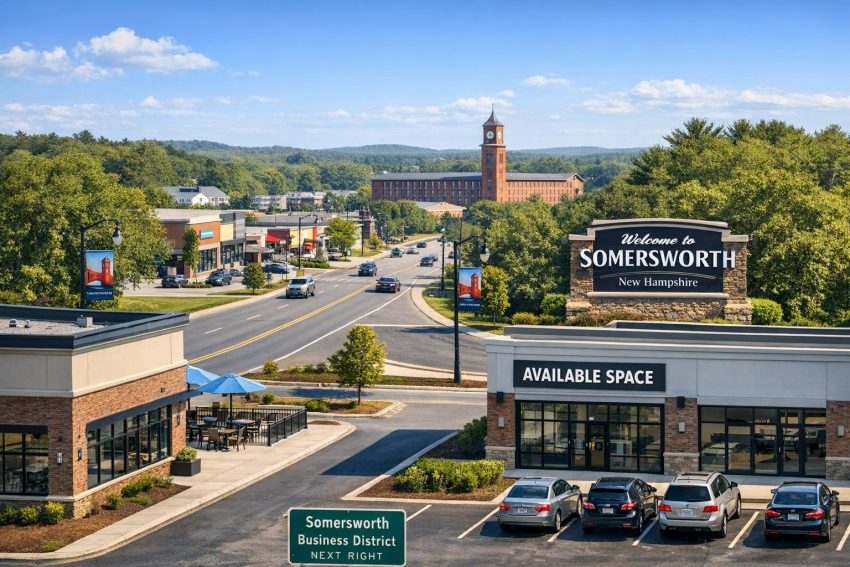
Somersworth, New Hampshire, sits in Strafford County along the Maine border. It’s not a big-city market, but it isn’t isolated either. The location within the Seacoast corridor—plus the proximity to Dover, Portsmouth, Rochester, and parts of southern Maine—creates a steady flow of business activity. For investors, that usually translates into a familiar mix: older commercial buildings finding new uses, tenants trading up or down based on cost, and redevelopment that’s more incremental than explosive.
This matters because commercial real estate in secondary markets like Somersworth rarely rewards guesswork. The smart money tends to come from understanding what local businesses actually need, how zoning and site constraints affect redevelopment, and which property types can perform consistently even when the rest of the market is doing its usual “mixed signals” thing.
Regional Context and Economic Position
Somersworth is part of the broader Seacoast and Southern New Hampshire employment and commerce pattern. Route 16 (the Spaulding Turnpike) runs nearby and links Portsmouth toward the Lakes Region, which also connects businesses to Interstate 95. Practically speaking, that gives tenants in Somersworth reasonable access to both near-term labor markets and longer-distance distribution routes.
Another practical point: higher-cost areas like Portsmouth can push some demand outward. When rents climb and land supply tightens, retailers, contractors, and small manufacturers sometimes start looking at “the next town over.” In that context, Somersworth can benefit from spillover economics: not everyone wants the most expensive address, but many still want predictable access to the same customer base and transportation routes.
Major nearby drivers
The regional economy is diversified, which helps. In the surrounding area you’ll see healthcare, education, light manufacturing, retail trade, hospitality, and professional services. Employment anchors like Wentworth-Douglass Hospital in Dover create consistent demand for medical and service space. Portsmouth brings tourism and maritime activity, along with professional services and offices. All of that can support a demand spill into Somersworth—especially for convenience retail, service businesses, and certain kinds of small office and industrial use.
For an investor, the lesson is straightforward: Somersworth doesn’t depend on one massive employer. Demand is more “distributed,” which can mean fewer dramatic ups and downs—though it also means lease-up speed can be slower when properties require specialized tenant fit.
Property Types That Show Up Most Often
Somersworth has a noticeable legacy of industrial land and older buildings, including mill structures tied to textile manufacturing. Along with that, the city contains commercial corridors, mixed-use pockets, and small office spaces. The performance of each segment depends heavily on building condition, site layout, and how well the property matches modern tenant requirements.
Most investment opportunities you’ll see fall into a few real categories: industrial/flex, retail and small neighborhood centers, office (often smaller professional spaces), and mixed-use or adaptive reuse projects where older structures get repurposed.
Industrial and Flex Space Opportunities
Industrial real estate is often the most straightforward segment to underwrite in a secondary market—mostly because tenant needs are clear. For Somersworth, there’s additional opportunity due to older industrial stock. Those buildings may not be “turnkey,” but they can become valuable if repositioning is done correctly.
Why older industrial buildings can still work
Many historic mill buildings and industrial parcels were designed around a different manufacturing era. That can show up as low ceiling heights, dated mechanical systems, or layouts that need redesign. But that’s also why some buyers find value: if you can modernize the structure and make it operable for light manufacturing, warehousing, or distribution-adjacent uses, you may create a product tenants are willing to pay for.
Investors typically focus on practical upgrades: updated electrical service, better HVAC where required, improved loading access, and code-compliant life safety and fire protection systems. Climate control matters more than people expect, especially when a facility sells to retailers or handles stored goods that can’t tolerate wide temperature swings.
Last-mile distribution and light logistics
E-commerce changed retail, but it also changed where inventory sits. Even small regional markets can benefit from last-mile or “penultimate” distribution—facilities that support nearby deliveries without the rent levels of the largest logistics hubs.
Somersworth’s proximity to Route 16 is relevant here. Tenants evaluate access and travel time, and investors benefit when the property can support truck access and turnaround, adequate parking, and simple logistics movement on-site.
In terms of pricing, industrial rents in smaller New Hampshire markets often land below Portsmouth or more urbanized areas. That can be attractive for tenants and profitable for investors, but it does raise the standard for operations: you still have to keep expenses predictable. Older building ownership means your budget should assume maintenance, roof work, and periodic mechanical replacement—because that’s how time behaves.
What tenants tend to screen for
Industrial tenants don’t usually buy regrets. They typically want:
- Clear access and loading (drive-in doors, workable dock or ground-level loading, and safe vehicle circulation)
- Reliable utilities (especially electrical capacity and dependable HVAC when needed)
- Reasonable site functionality (parking for employees and space for trucks)
- Modifiable layout (open spans and ceiling heights that won’t require fantasy engineering)
If your asset checks those boxes, lease negotiations tend to be more about term length and tenant improvements than about whether the building is even usable.
Retail Real Estate and Changing Consumer Patterns
Retail in Somersworth tends to revolve around neighborhood shopping, standalone commercial buildings, and smaller centers rather than large, destination-style retail. The customer base is mostly local and regional—tourism exists in the broader region, but it doesn’t usually operate like a daily traffic engine for every storefront in Somersworth.
That shapes investor behavior. In markets like this, retail performance is less about marketing hype and more about tenant type, lease structure, and foot traffic patterns that don’t collapse when internet shopping gets a little louder.
How e-commerce affects local retail tenants
Brick-and-mortar didn’t disappear; it got selective. Businesses with in-person value generally keep stronger demand. Medical clinics, dental offices, physical therapy, fitness, specialty services, salons, and restaurants tend to hold up better than pure “commodity retail.” Quick-service food can also perform well when location visibility and parking work in real life, not just on paper.
Retail investors often treat tenant quality as a core risk factor. A weaker tenant can drag a center down, not only through vacancies but through maintenance neglect and weaker rent collection habits. In smaller markets, that kind of disruption can take longer to reverse.
Downtown storefronts and mixed-use potential
Somersworth’s downtown and nearby commercial blocks can offer opportunities for mixed-use. The pattern you’ll commonly see is ground-floor retail paired with residential space above, or the redevelopment of older structures into a combination of office, retail, and sometimes housing.
Mixed-use can reduce vacancy risk by diversifying income streams. But it doesn’t automatically improve returns. Performance hinges on lease terms, tenant selection, and how long it takes to stabilize common areas and building systems. Many “mixed-use” projects are essentially two businesses: a retail leasing job and a residential leasing job. If one side drags, the other side can’t always carry it.
Office Market Conditions: Smaller Assets, Real Constraints
Office space in Somersworth exists, but it isn’t a massive corporate-office market. Most office holdings are smaller—professional buildings, converted spaces, or areas included in mixed-use developments. Tenants often include attorneys, accountants, insurance agencies, therapists, and nonprofit-related offices.
Remote and hybrid work, in plain terms
The shift to remote and hybrid work affected office demand nationwide. In smaller markets, it tends to show up as moderated vacancy and slower leasing rather than a dramatic collapse. Some businesses reduce space. Others move to more affordable property. A subset decide they still need physical presence but don’t need as much of it.
For owners, the implication is that the “average” office lease demand may shift toward smaller suites, flexible layouts, and buildings that reduce operating friction. If your building has outdated HVAC, poor parking access, or layout constraints, prospects will notice.
What matters for office tenants looking in Somersworth
Office tenants commonly evaluate:
- Parking and access (clients and staff still need to get there)
- Building condition (especially mechanical systems and windows)
- Suitability for subdivision (ability to rent smaller suites or adapt floor plans)
- Compliance (current code and reasonable operational standards)
Energy efficiency is also a quiet selling point. In practice, operating expense surprises can sour leasing relationships. Owners who can document building performance and keep utility costs under control usually do better, or at least negotiate from a less awkward position.
Adaptive Reuse and Mixed-Use Redevelopment
In Somersworth, adaptive reuse is one of the more meaningful themes. The former mill inventory near the Salmon Falls River offers a foundation for redevelopment into residential units, office space, and light commercial uses. This isn’t a new story for the Seacoast region, but Somersworth’s share of that trend matters because it creates investment opportunities that combine design value with practical leasing.
Why mills get converted
Historic mill buildings bring two things investors like: character and bulk. “Character” helps marketing and attraction, while “bulk” provides usable square footage that can often be reconfigured. The tradeoff is cost and complexity—historic structures can involve unknowns in the walls, old wiring, structural adjustments, and the usual surprises that show up when demolition stops being a theory and turns into a physical event.
Projects can also work when they align with incentives. Historic tax credits and other state or federal programs might apply depending on the specifics of the building and intended use. If you’re modeling a deal like this, verify eligibility early rather than hoping your accountant can do miracles in September.
How income stacks up in mixed-use conversions
Mixed-use projects can stabilize cash flow by layering tenants: ground-floor commercial tenants can support street visibility, while upper-floor residential units provide a different customer base and revenue timing. Still, developers need to manage both sides carefully.
Residential demand depends on unit finish quality, parking, rent levels that match local income and commuting patterns, and property management execution. Retail or office demand depends on leasing strategy, tenant mix, and shared maintenance planning.
When owners plan this well, the redevelopment can perform. When they don’t, it becomes a long-term occupancy headache.
Zoning, Permitting, and Site Plan Realities
Zoning is where deals either become practical—or stall at the worst possible moment. In Somersworth, commercial, industrial, and mixed-use zones exist with use and dimensional requirements. Buyers should verify permitted uses, parking requirements, and any signage rules before investing time into design or financing.
Entitlements and the timeline problem
For projects that require site plan review, variances, or special approvals, the entitlement timeline becomes a core underwriting factor. Some proposals fit naturally within planned uses and move through checks faster. Others require adjustments that trigger extended review, additional public input, or engineering redesign.
In smaller municipalities, the permitting path can be manageable, but it’s still a timeline. Investors avoid surprises by building realistic scheduling assumptions into their pro forma and by preparing for plan revisions if code enforcement or planning board requests change the scope.
Planning goals and neighborhood compatibility
Somersworth typically aims to encourage appropriate economic development while maintaining compatibility with neighborhood conditions. In practical terms, proposals that improve underutilized properties or expand the tax base, while fitting the general character of the area, can experience smoother review.
So if you’re evaluating a property and thinking, “This should be easy,” you may want to confirm whether the proposed use is as permitted as your broker’s optimism suggests. It’s not always a problem, just a frequent point of friction.
Infrastructure, Utilities, and Site Feasibility
Infrastructure can make or break a redevelopment plan. Somersworth includes municipal water and sewer services in many commercial areas. That’s often a clear advantage over rural markets where businesses depend on private wells and septic systems, or where wastewater capacity becomes a permitting hurdle.
Broadband and modern tenancy
Broadband access matters for office tenants, medical practices, and modern small industrial operations. Even some service businesses rely on stable internet for payments, scheduling, and communications.
When a building is old, investors can’t assume connectivity is fine. Due diligence should include confirmation of available internet providers and expected service levels, especially for office or clinic users.
Transportation and vehicle access
Somersworth’s proximity to Route 16 supports freight movement and commuter travel. While the city doesn’t operate like a passenger rail hub, nearby access to bus routes and airports in the region can support business travel needs. For many tenants, however, road access dominates the decision.
From an investing standpoint, you want to check the “boring stuff”: driveway width, turning radius, truck access, curb cuts, and whether the site can handle delivery frequency without turning customer parking into a daily traffic jam.
Utility capacity and older building upgrades
Older properties may need electrical system upgrades, especially if the tenant intent is light manufacturing, specialized equipment, or even upgraded office power demands. HVAC and plumbing can also require modernization.
These aren’t theoretical issues. If you discover them late in the deal process, they can consume your contingency budget and delay revenue. Basic due diligence—building systems review, utility confirmations, and early conversations with engineering—usually pays for itself.
Market Pricing, Capitalization Rates, and Investment Metrics
Commercial pricing in Somersworth generally sits below Portsmouth and coastal towns further south or east. Secondary markets often trade with somewhat higher capitalization rates, which reflects perceived risk, smaller tenant pools, and lower liquidity than primary markets.
That can be a benefit if you know what you’re buying. Lower acquisition cost can improve yield potential, but the math works only if the property can attract and retain tenants. Owning a “cheap building” that won’t lease is a special kind of expensive.
What lenders often care about
Lenders typically evaluate:
- Tenant credit quality and lease terms
- Building condition and capex requirements
- Loan-to-value comfort based on market comparables
- Borrower experience with similar assets and local market behavior
Owners with credible renovation plans often fare better when financing requires a clear path to stabilization. If you’re buying value-add, you’ll usually need a plan lenders can understand: how the property will improve, how leasing will work, and what timelines are realistic.
Liquidity and comparable sales
Small markets can have thinner transaction volume. This affects liquidity and can limit available comps. Buyers may need to use sales from nearby municipalities, then adjust for distance, property condition, and tenant mix.
This is where local knowledge becomes practical. You want to understand whether price differences are driven by real fundamentals or by just “seller behavior.” Those can look similar in numbers but behave differently over time.
Demographics and Workforce Trends
Somersworth has a population around the 12,000 resident range. Growth has been modest, and the broader Strafford County area has tended to show steadier expansion patterns. For commercial real estate, demographics work through household income, employment stability, commuting behavior, and consumer spending.
Many workers commute to Dover and Portsmouth. That supports the kind of demand you see in local services and convenience retail—food service, personal services, and small office activity aimed at nearby businesses.
Housing stock and spending power
Residential development—often connected to redevelopment of older structures—can indirectly increase spending for local retail, and can attract tenants to neighborhood-oriented commercial spaces. Renovated mill buildings that include housing can also bring density closer to the commercial corridors, improving leasing velocity for compatible retail and service businesses.
Aging population considerations
New Hampshire’s aging population trend can create opportunities for healthcare-adjacent uses. Medical offices, outpatient services, and specialized care facilities may find a local demand base over time.
For investors, the operational note is simple: healthcare users have regulatory and buildout expectations. Their leases can be attractive, but building systems, parking, ADA compliance, and medical-grade requirements must be treated seriously during underwriting.
Risks and Constraints You Should Actually Expect
Every market has risks, but secondary markets tend to concentrate them. Instead of many small shocks, problems can show up as longer vacancy times, slower re-leasing, or capex that arrives all at once.
Tenant concentration
In smaller cities, a few tenants can represent a meaningful portion of rent. If a major tenant leaves or downsizes, cash flow can take a visible hit. Even if the building is leased today, investors should check tenant stability and lease expiration schedules.
Spreading risk helps. If you have one anchor exposure, you usually want to know what happens on day 367, not just day one.
Environmental and site legacy issues
Former manufacturing properties may require environmental assessments. A Phase I Environmental Site Assessment is typically the first step, and a Phase II can follow if Phase I results suggest potential contamination. Floodplain considerations may also apply near riverfront areas.
These aren’t deal breakers by default, but they should shape your diligence timeline and your budget. Insurance and compliance costs can change after assessments, and those costs feed directly into underwriting.
Financing and interest rate sensitivity
Interest rates affect debt service and valuation metrics across the board. In secondary markets, the margin for error can feel smaller because some buyers are more cautious and lenders may be less flexible on assumptions.
Conservative underwriting helps: you want to assume reasonable vacancy, realistic rent growth, and a capex plan that reflects the reality of older assets. If your assumptions are too optimistic, refinancing risk becomes more than a theoretical concern.
Long-Term Outlook for Commercial Real Estate in Somersworth
Somersworth’s commercial real estate future is closely connected to regional stability and ongoing infrastructure investment. As the Seacoast area continues to develop, demand for cost-effective commercial locations can persist. Somersworth’s relative affordability, older building stock ready for redevelopment, and connections via major roads support that trend.
That said, the market is unlikely to behave like a boomtown. Large speculative projects may be less common. Instead, you may see growth through redevelopment: older properties updated for contemporary use, downtown improvements that increase street-level activity, and targeted projects tied to demonstrated tenant demand.
What investors tend to favor
Investors who do well in markets like this usually focus on:
- Steady cash flow from tenants with durable demand
- Adaptive reuse where the building can be made functional and compliant
- Service-oriented uses that rely on in-person activity and local convenience
When those pieces align, returns can be reasonable and risk can be managed without turning the project into a perpetual construction saga.
How to Approach Underwriting in This Market Type
Somersworth isn’t difficult, but it’s not forgiving. Underwriting should match the market’s reality: smaller tenant pools, slower transaction volume, and a higher need for diligence on building systems, zoning, and environmental constraints where relevant.
Start with the property, not the story
It’s tempting to pitch redevelopments as “once-in-a generation” opportunities, mainly because everyone likes the sound of it. But lenders and future tenants care about functionality. Start with questions like:
- Can the building meet tenant requirements without major reconfiguration?
- Is the site layout workable for parking, access, loading, or patient/client flow?
- What permit steps would you face, and what timeline should you assume?
- What’s your capex plan from year one to year five?
Answer those with supporting documentation, and the rest becomes easier to estimate.
Use nearby market data more carefully than usual
Comparable sales in small markets can be scarce. That doesn’t mean they’re useless, but it does mean you should adjust them with discipline. Consider how differences in condition, location visibility, proximity to employment centers, and lease structure can shift market behavior.
If you price too aggressively based on comps that represent a different level of tenant demand, you’ll likely face leasing friction later. If you price conservatively and your property is truly an easier tenant match, you may lease faster than you think—always a nice spreadsheet surprise.
Where Somersworth Offers Practical Opportunities
It’s not just “opportunities” in the abstract. Somersworth’s best prospects tend to cluster around practical needs: operationally viable industrial and flex spaces, retail that supports in-person services, office spaces that can be subdivided or used by local professional tenants, and adaptive reuse projects that convert legacy structures into usable, code-compliant property.
In other words, the market rewards investors who buy buildings they can fix, reposition, and lease to tenants who actually fit the product. That’s less glamorous than buying “the next big thing,” but it’s how most stable investment stories stay stable.
In summary, commercial real estate opportunities in Somersworth come from the city’s regional connectivity, steady employment-adjacent demand, and ongoing adaptive reuse of older properties. The market doesn’t promise rapid volatility, and it doesn’t reliably reward rushed decisions. For investors who run thorough due diligence—focusing on zoning, building systems, environmental considerations where applicable, and realistic operating assumptions—Somersworth can offer measured, workable returns in a Seacoast market that changes at a human pace.