Forex trading in Somersworth is not a local market in the ordinary sense. There is no Somersworth foreign exchange hub, no regional dealing desk, and no special local edge tied to the city itself. A trader sitting in Somersworth is participating in the same global currency market viewed by traders in Boston, Dallas or Singapore, usually through an online broker offering spot forex or forex CFDs depending on the account structure and jurisdiction. The market is global. The local angle is practical, not strategic. It affects taxes, work routine, internet access, market hours and the sort of trading style that fits ordinary life. It does not change how EUR/USD behaves.
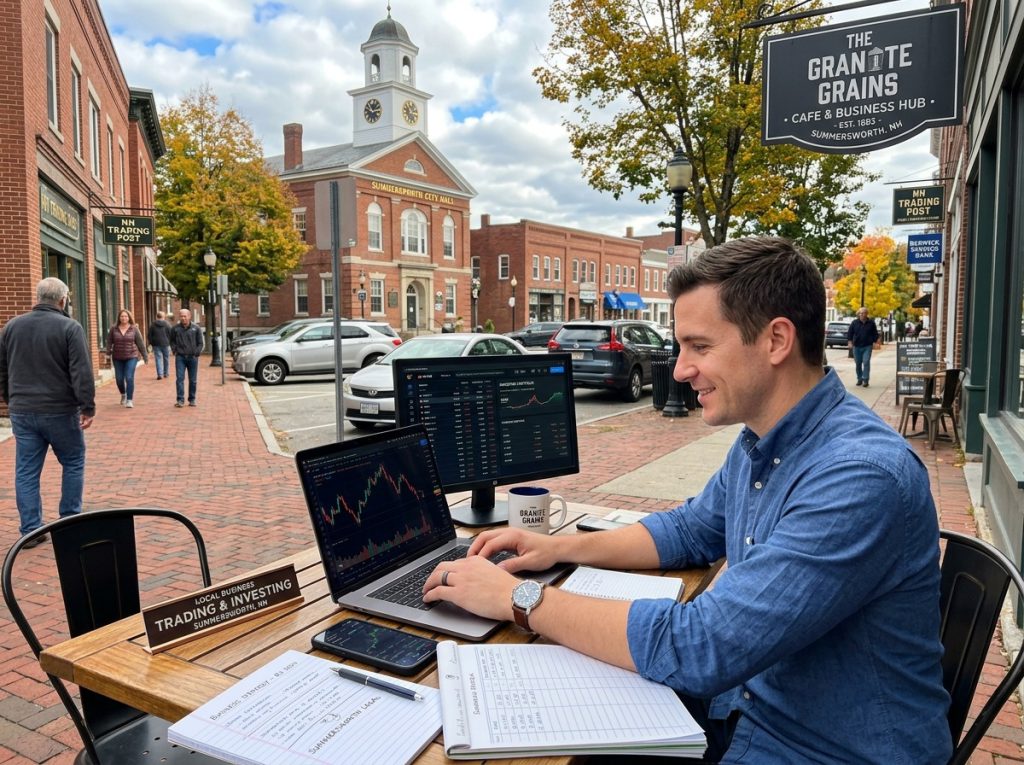
Somersworth is a small New Hampshire city with an estimated 2024 population of 12,218, according to New Hampshire Employment Security and the U.S. Census QuickFacts. That size matters only in a mundane way. Most traders based there are likely to be retail traders working from home rather than professionals sitting inside an institutional environment. That makes style selection more important. Trading methods that depend on constant execution speed and a six screen setup tend to age badly in ordinary home settings. Forex can still be traded from Somersworth, obviously, but the sensible version usually looks more like swing trading or measured position trading than frantic short term clicking dressed up as sophistication.
So the useful question is not whether forex trading is possible in Somersworth. It plainly is. The better question is what rules apply, what risks actually matter, and how a trader in a place like Somersworth can build a process that is realistic rather than aspirational.
The legal and regulatory framework: who regulates retail forex for a trader in New Hampshire
For a trader in Somersworth, forex regulation is federal and broker based, not municipal. The city of Somersworth does not regulate retail forex trading. New Hampshire does not run a separate local forex rulebook for ordinary retail speculation. In practice, the main U.S. framework sits with federal agencies and registered firms. That is the first thing many retail traders get wrong. They look for a local yes or no answer when the real issue is whether the broker and account structure are legal and properly supervised in the United States.
The main federal reference points are the Commodity Futures Trading Commission and the National Futures Association, with general investor education also available through Investor.gov. The CFTC’s rules on off exchange retail forex are laid out in 17 CFR Part 5, which includes formal risk disclosure language for retail foreign currency transactions. Investor.gov’s forex bulletin also states plainly that forex trading can be very risky and is not appropriate for all investors, especially because leverage is common in the product. That warning is not decoration. It is the core of the business.
That matters for anyone in Somersworth because the real due diligence is not “can I find a broker online.” The real due diligence is whether the broker is registered where it should be, whether the account terms make sense, and whether the firm is offering the product lawfully to U.S. residents. A broker accepting U.S. clients without the right registration is not a clever workaround. It is a problem with a marketing budget. The CFTC has continued to discuss retail forex market structure and the registration categories created for off exchange retail forex, which is a reminder that this is a supervised, not improvised, area of the market. Forexbrokersonline.com can help you find a good retail forex broker that welcomes traders from Somersworth.
The local regulatory angle inside New Hampshire is mostly indirect. New Hampshire does not impose a state personal income tax on ordinary wages, and the state’s Interest and Dividends Tax was repealed for tax periods beginning after December 31, 2024, according to the New Hampshire Department of Revenue Administration. That affects the tax setting for a trader living in Somersworth, but it does not replace federal compliance, federal broker rules or federal reporting obligations. Traders sometimes hear “tax friendly state” and behave as if that somehow reduces market risk or legal responsibility. It does not. It just changes one layer of the operating environment.
So the legal picture is straightforward. A trader in Somersworth is not entering a special New Hampshire forex regime. He is entering the U.S. retail forex regime from a New Hampshire address. That sounds less exotic than many online ads suggest. Good. Exotic is usually where the trouble starts.
Why location matters less than traders think, and more than they admit
Location does not create a price edge in forex. The euro does not care that the trader is sitting in Strafford County. The dollar does not move differently because the desk is in Somersworth rather than Salem. That part is easy. The harder part is that location still matters in practical ways traders tend to ignore until those details start costing them money.
The first practical point is time zone. Somersworth sits in the U.S. Eastern Time zone, which is useful for forex traders who want access to the North American session without turning trading into a night shift. A New Hampshire based trader can review London session developments in the morning and trade or manage positions through the New York overlap during ordinary waking hours. That is not a magical edge, but it is a real convenience. A trading routine that fits human hours is easier to maintain than one that depends on pretending sleep is optional.
The second point is work environment. Most retail traders in a city the size of Somersworth are working from home or from a simple personal setup. That is not a weakness if the style fits the setting. The trouble begins when traders try to imitate high frequency habits from social media instead of choosing a process suited to their actual life. Short term forex trading can look exciting, but from a normal home environment it often becomes a machine for overtrading, noise exposure and bad decisions. A slower routine with defined setups and fewer trades is usually more realistic. That is not because Somersworth is unusual. It is because ordinary life is ordinary life.
The third point is infrastructure backup. The Somersworth Public Library offers free Wi Fi 24 hours a day, seven days a week, and provides public computers during open hours. Its current posted hours are Tuesday and Wednesday from 9 a.m. to 7 p.m., Thursday and Friday from 9 a.m. to 5 p.m., and Saturday from 9 a.m. to 1 p.m. No serious trader should build a leveraged forex business around public library internet, but as a redundancy option during home connection issues, it is useful. Trading from home always sounds simple until the router decides otherwise.
So yes, location matters less than traders think in terms of price edge. But it matters more than they admit in terms of process stability. Forex rewards consistency. Boring conditions help more than traders like to say.
Broker selection, account setup and platform decisions
For a trader in Somersworth, broker selection is where the adult version of forex begins. A weak broker can ruin a decent process faster than a mediocre indicator ever will. This is why the first question should not be about spreads or leverage. It should be whether the broker is properly registered, transparent about risk, clear on execution terms and honest about how orders are handled. The CFTC and NFA exist for a reason. Traders who treat broker regulation as a footnote usually learn the reason later, and at a cost.
The U.S. retail forex framework is already a clue about what matters. If federal regulations require extensive risk disclosure for off exchange foreign currency transactions, then the trader should assume this is not a product where casual broker shopping makes sense. The broker should disclose execution conditions, margin policies, fees, rollover practices and risk warnings in a way that can be read without needing a translator or a miracle. If the website leads with lifestyle imagery and hides the legal entity, that is usually enough information already.
Account setup also deserves more thought than it gets. A trader in Somersworth may be tempted to open multiple accounts across multiple platforms in the name of flexibility. Usually it is just clutter. One properly chosen account, one clear base currency, one platform that works reliably and one record keeping process are better than a messy collection of half used broker logins. Simplicity is underrated in trading because it looks less impressive than complication. The account does not care.
Platform decisions should follow the same logic. Retail traders tend to spend too much time comparing chart colors and not enough time checking whether the platform handles alerts, order types, position sizing and execution reports cleanly. A platform should make it easier to trade a plan, not easier to improvise. That sounds obvious, yet many traders choose systems that encourage constant tinkering, then wonder why discipline keeps leaking out the sides.
This is where the Somersworth angle returns in a useful way. Because the likely setup is a home office rather than an institutional desk, the platform needs to be stable under ordinary conditions. It should work well on one or two screens, provide clean mobile access when needed and not depend on an elaborate hardware setup to be usable. Retail trading has enough friction already. A system that requires theatrical complexity usually gives less than it takes.
The dry truth is that broker and platform choices are not secondary decisions. They are part of the strategy. A trader who wants to operate from Somersworth with minimal drama should pick the boring, regulated, readable option over the flashy one every time. In forex, boring tends to age well.
Risk management, leverage and the reality of retail forex
Most retail forex failures are not analytical failures. They are sizing failures. The trader is often directionally reasonable, occasionally even quite good, but uses leverage in a way that makes ordinary market movement intolerable. This is why the standard federal warnings focus so heavily on leverage. Investor.gov says plainly that forex trading can be very risky and is not appropriate for all investors. That is not because currencies are mysterious. It is because leverage makes small moves matter too much.
A trader in Somersworth does not face a different version of this problem. He faces the same problem from a smaller room. If the account is overleveraged, the fact that New Hampshire has a pleasant tax profile will not help. If the trader is running positions too large into central bank decisions or U.S. data releases, the quiet local setting will not help either. Forex remains a market where being early can feel identical to being wrong, and being slightly wrong at size can be enough to damage the account badly.
This is one reason slower trading styles tend to fit ordinary retail traders better. A trader who holds fewer positions, sizes them properly and accepts that not every day needs a trade is already doing more real risk management than a large portion of the market. That sounds almost insultingly simple. Good. The market tends to punish people who think the hard answer must be more complicated than the true one.
Another issue is correlation. Retail forex traders often believe they are diversified because they hold several currency pairs. Often they are just holding the same dollar view through several doors. Long EUR/USD, long GBP/USD and short USD/CHF may look like three trades. In many market conditions it is one trade with costume changes. The same problem appears around commodity currencies or yen crosses. Correlation becomes visible only when the move goes against the trader all at once, which is usually a rude moment to discover it.
The fix is not clever. It is disciplined. Risk a small, pre defined amount per trade. Treat event risk as real. Assume that overnight positions can gap, that stops can suffer slippage and that a string of ordinary losses is not proof of sabotage. Retail traders are often desperate to explain losses with villainy when ordinary bad sizing already explains enough.
Operating from Somersworth may help a little only because the environment is less saturated with institutional theater. There is less social pressure to look busy. That matters. Good forex trading often looks inactive from the outside. The trader studies, waits, sizes modestly and does not confuse motion with quality. The internet hates that because it is hard to sell screenshots of patience. The account tends to like it more.
Taxes, records and operating from Somersworth
New Hampshire is a better place to live as a trader than many states if the question is state level tax friction. The state’s Department of Revenue Administration confirms that the Interest and Dividends Tax was repealed for tax periods beginning after December 31, 2024. In practical terms, that means a trader in Somersworth is not dealing with a general New Hampshire state income tax layer on trading results in the way traders elsewhere may face state tax claims on top of federal obligations. That is a real operating advantage, even if it is not a trading edge in the market sense.
It is still not a free pass. Federal tax reporting remains federal tax reporting. Account statements, realized gains and losses, transfer records and year end documentation still need to be kept properly. Traders often romanticize the market part and neglect the paperwork until tax season arrives with its usual bad timing and complete lack of sympathy.
Record keeping is easier if the setup is clean. One broker, one platform, one funding route and one folder for monthly statements already solves a surprising amount of future pain. Traders who route money through several accounts, use multiple platforms casually and mix personal transfers with trading flows usually create their own compliance fog. Fog is bad for driving, and worse for finance.
From a Somersworth perspective, the message is not dramatic. The city does not add a special tax burden. New Hampshire is relatively friendly on the state side. That is useful. It does not remove the need to behave like a serious adult with records.
Conclusion: when forex trading in Somersworth is sensible and when it is not
Forex trading in Somersworth makes sense when it is treated as global market speculation conducted from a small New Hampshire city, not as a local shortcut to income. The city does not change forex mechanics, but it does offer a workable setting for traders who want an Eastern Time routine, a relatively clean state tax backdrop and a home based process that does not depend on constant screen time.
It makes less sense when the trader is chasing speed, leverage and broker novelty for their own sake. The regulatory framework is federal, the risks are the standard retail forex risks and the main local advantage is that Somersworth does not get in the way. That is enough, provided the trader respects the dull parts: regulated brokers, modest size, proper records and a routine that can survive ordinary life. In trading, the setup that looks least glamorous is often the one with the best chance of still being alive next year.