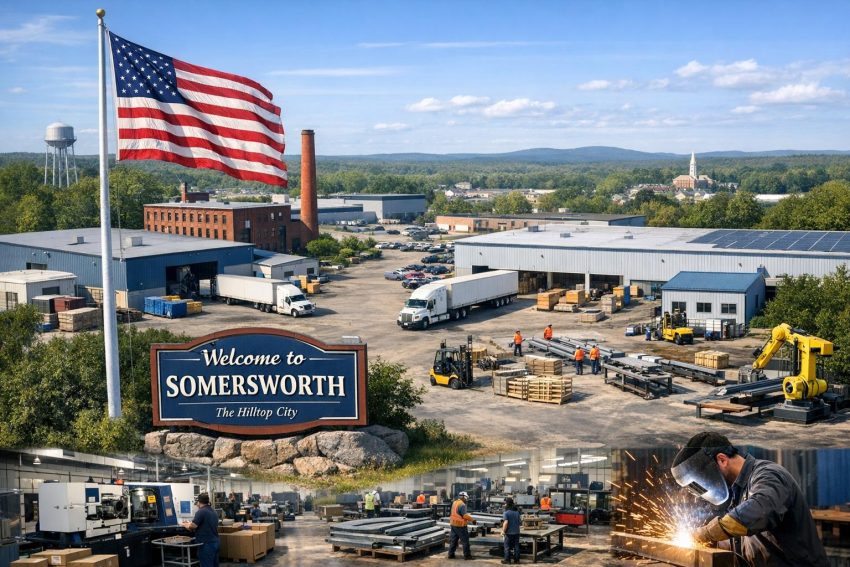
Somersworth, in Strafford County, sits in the southeastern corner of New Hampshire, a short hop from Maine and not far from the Seacoast hubs that businesses already know by name. The city’s industrial identity goes back to the Salmon Falls River, where early textile and mill operations used waterpower and built the kind of working-town infrastructure that many newer industrial areas just don’t have. The big mills faded over time, but the physical bones—factory buildings, transportation access, industrial zoning, and a workforce used to mechanical and production work—didn’t disappear with the yarn looms.
For brokers and operators evaluating where a facility can make money without paying metropolitan prices for every square foot, Somersworth has a practical pitch. It’s not a giant logistics megacity, and it doesn’t pretend to be. It’s a mid-sized industrial location with enough connectivity to serve New England markets and enough working space to support industrial and light manufacturing activities. What follows is a detailed, grounded look at the factors that matter when selecting and brokering manufacturing real estate in Somersworth, including the constraints that show up when you’re doing the math for a real project.
Why Somersworth Still Matters for Manufacturing
New England has plenty of places where manufacturing happens, but not all of them offer the same mix of costs, access, and usable buildings. Somersworth’s advantage is that it sits at the overlap of several practical needs:
1) Existing industrial structures that can often be repurposed rather than rebuilt from scratch.
2) Access to Route 16 and connections that feed into Interstate 95, plus nearby labor markets.
3) Industrial zoning that tends to accommodate light manufacturing, assembly, and warehousing.
4) A regional training pipeline that supports trades and technical roles.
None of those are magic. They’re just the things that reduce friction when you’re trying to open a shop, scale production, or relocate a supply-chain node.
Historical Industrial Foundation
Somersworth’s industrial roots trace back to early mill complexes along the Salmon Falls River. Waterpower wasn’t just a convenient power source; it shaped where factories could exist, how they were laid out, and what kinds of workers the town attracted. Over decades, the city developed an industrial footprint that influenced roads, workforce housing patterns, and work routines.
Former mill buildings weren’t built for modern compliance, but they’re built to last
Industrial buildings from the nineteenth and early twentieth centuries often have thick walls, durable structural systems, and layouts that can accommodate manufacturing loads. That’s a mixed bag from a redevelopment perspective—because old buildings still need upgrades—but it also means you’re not always starting with an empty lot and a blank architectural render.
Many older industrial spaces can be adapted to modern uses such as:
- Light manufacturing and fabrication lines
- Warehouse and distribution operations
- Specialty food processing with the right mechanical buildout
- Small-batch packaging and assembly
- Workshop-style production (machining, woodworking, millwork)
Renovation costs and code compliance requirements still matter, especially for electrical distribution, HVAC, ventilation, and worker safety. But in a deal, having an extant structure can reduce the uncertainty that comes with raw land.
The shift from heavy textile to smaller-scale industry
As textile production declined across parts of New England in the mid-20th century, Somersworth shifted toward smaller-scale manufacturing and service-oriented business activity. This transition left behind industrial-zoned parcels, reinforced building stock, and established transportation corridors. Those leftovers are the real “inventory” behind many current leasing and sales conversations.
When a broker looks at asking prices and vacancy patterns, they’re often looking at how well that older stock has been maintained, retrofitted, or divided into workable units. Somersworth has plenty of the original bones; the question is how many of them can be moved into a modern production workflow without becoming a money pit.
Geography and Transportation Advantages
Location matters more for manufacturers than people sometimes expect. The facility is where product gets transformed, but the business model depends on how you reach suppliers, move raw materials in, and ship finished goods out. Somersworth’s geographic position supports that entire cycle.
Route 16 (Spaulding Turnpike) connects the dots
Somersworth sits within reach of major transportation routes, particularly Route 16 (the Spaulding Turnpike), which links to Interstate 95. That is the practical connection to the broader Seacoast region and southern New England markets where demand, distribution, and third-party logistics services cluster.
In everyday terms: a local production shop can be staffed by people who live in neighboring towns, deliveries can keep schedules reasonably intact, and companies can distribute to the wider regional customer base without treating logistics as a continuous emergency response.
Close enough to key commercial centers
Local travel times are generally manageable. Portsmouth is roughly 15 miles away, Dover sits adjacent, and Rochester is within a short drive. Portland, Maine and Manchester, New Hampshire are typically within about an hour depending on traffic and weather.
This matters for two reasons:
- Sales cycles and customer visits happen without turning site visits into all-day events.
- Employee commuting stays realistic for skilled trades and technical roles.
Many manufacturing operators eventually end up competing with other industries for labor, and in a small-to-mid labor market, “reachable by car within a reasonable window” is a benefit you can feel during hiring season.
Air cargo and shipping options
Somersworth itself doesn’t have a commercial airport within city limits, but air cargo and passenger service are accessible via Portsmouth International Airport at Pease and Manchester–Boston Regional Airport. For many light manufacturing operations, that’s enough to handle situations like time-sensitive components or supplier shipments for specialized parts.
Port maritime shipping isn’t unlimited from Somersworth because the Port of Portsmouth has limited capacity compared to a larger deep-water port. Still, Portland, Maine offers expanded shipping possibilities, which matters for import components and export products.
Remember: even if most manufacturing is shipped by truck, the availability of sea routes in a nearby region can improve supplier options and freight pricing strategies.
Industrial Zoning and Available Land
Industrial land and zoning are often the unsexy part of a deal, but they decide whether a project is feasible. Somersworth has designated areas where commercial and industrial development is expected. These zones commonly support light manufacturing, assembly, warehousing, and research-related uses.
Move-in ready space exists, not just theoretical potential
Somersworth has industrial parks and converted mill structures that can function as leasing options for smaller and mid-sized firms. For many operators, “move-in ready” isn’t about cosmetics; it means:
- adequate electrical capacity
- usable loading access
- clear fire/life safety pathways
- space that can support production layout
- manageable HVAC and ventilation options
These are the details that show up in inspections and tenant improvement budgets. A broker who does site tours regularly knows which buildings are flexible and which ones trap tenants with hidden retrofitting costs.
Cost comparisons with bigger cities
Relative to major urban areas like Boston or Cambridge, property and operating costs in Somersworth tend to be lower. For manufacturers, the biggest immediate difference shows up in the price per square foot for production and storage space. Over a five-year lease term, that can matter more than any promotional wage subsidy pitch.
Somersworth does have limitations too: compared with less-developed rural regions, available land may be more constrained. Still, for light industrial users, the trade-off often works if the building stock is functional enough or if a smaller footprint expansion is all that’s needed.
Adaptive reuse is common, but start with the building survey
Adaptive reuse is one of Somersworth’s most relevant angles. Former mill buildings and industrial structures can often be retrofitted for specialty manufacturing, artisanal production, food processing, or small-scale fabricating operations.
But “can be retrofitted” depends on a real building-by-building assessment. Before a financial model gets too excited, you want clarity on:
- structural load capacity for equipment
- ceiling height and bay spacing
- floor flatness and slab conditions
- ventilation feasibility for your processes
- upgrade path for electrical and compressed air needs
Energy efficiency improvements and building code compliance will almost always be part of the modernization plan. That cost should be treated as a normal step, not treated as a surprise disaster.
Workforce Characteristics and Training Pipelines
For light manufacturing, workforce availability often determines speed of growth more than any marketing deck. Somersworth and the surrounding Seacoast communities offer a labor pool with experience in manufacturing, technical trades, and mechanical services.
Community college and vocational training help with basics—and the “in-between” skills
Nearby Great Bay Community College (in Portsmouth) offers technical training programs in advanced manufacturing, machining, and industrial maintenance. That matters not only for new hires, but also for upskilling existing employees and keeping retention efforts grounded in actual training opportunities.
In many operations, the training gap isn’t about teaching someone how to read a blueprint from scratch. It’s about teaching consistent machine setup habits, safety protocols, and troubleshooting workflows. Those are skills that vocational programs can reinforce.
Labor competition exists, but manufacturing can still win
Seacoast employers do compete with each other. Workers commute from Dover, Rochester, and points in southern Maine. New Hampshire’s unemployment rate has generally been low, which means the labor market tightens when demand rises.
However, light manufacturing firms sometimes have an edge over retail or hospitality if they offer stable schedules, clear advancement paths, and work that doesn’t feel like guesswork. Candidates also tend to value safe facilities with predictable processes. A shop that can explain why it’s a good place to learn tends to hire better than a shop that just posts “we’re hiring” and hopes for the best.
Target Sectors for Light Manufacturing
Somersworth is best aligned with light manufacturing rather than heavy industry. The general fit comes down to emissions profiles, land use needs, transportation intensity, and workforce requirements.
A practical rule of thumb: operations employing roughly 10 to 150 people, generating limited emissions, and relying on truck-based distribution often match the profile well.
Precision machining and small-batch fabrication
Precision machining fits the typical manufacturing pattern in New Hampshire and Maine: smaller operations, specialized output, and relationships with engineering-focused firms. There are also defense-related suppliers throughout the broader region. Because many defense workflows depend on quality control and repeatable processes, the facility needs good layout control, reliable power, and disciplined maintenance cycles.
Somersworth’s advantage is that these operations don’t always need massive industrial campuses—just functional production space close enough to suppliers, engineering contacts, and a workable labor pool.
Food and beverage production (with the right facilities)
Craft food processing and small-scale beverage manufacturing can work when the building supports industrial kitchen requirements, cleaning workflows, and packaging lines. Food use is more regulated and more inspection-friendly if you design for it early.
Also, proximity to Seacoast tourism and regional retail can strengthen local market relationships. Even when production ships elsewhere, local demand can help stabilize a small operation’s sales cycle.
Wood products and custom millwork
New Hampshire’s forestry and wood supply traditions support manufacturers making cabinetry, fixtures, architectural components, and custom millwork. These operations can often work inside light industrial zones without needing the heavy rail infrastructure that larger industrial manufacturing might require.
Still, wood-product businesses need to plan for dust control, ventilation, and fire-safety considerations. A building that was originally designed for textile or general manufacturing may already include certain features, but you still verify everything in context of your specific processes.
Clean technology assembly, electronics assembly, and light medical production
These sectors can fit if environmental and compliance plans are built from day one. Clean assembly and electronics workflows depend on stable work environments, careful handling, and consistent procedures.
Light medical device production (even at small scale) often requires strict quality systems and documentation. Again: the facility matters, but so does the operational structure you bring into it.
Regulatory and Tax Environment
Manufacturing location decisions often get reduced to three things: taxes, compliance burden, and predictability. New Hampshire is frequently described as business-friendly because it does not impose a general sales tax and it does not levy a personal income tax on wages. That said, businesses still face taxes relevant to operations.
Business Profits Tax and Business Enterprise Tax
Employers should understand how New Hampshire’s Business Profits Tax and Business Enterprise Tax affect manufacturers. For a broker, it’s not about calculating tax liabilities in a listing flyer—but it is about ensuring the buyer or tenant’s financial team has the right information early.
Manufacturing also has timing considerations: tax planning impacts how cash flow is modeled for equipment purchases, hiring, and ramp-up schedules.
Property tax rates vary by municipality
Somersworth sets its own property tax rate. For manufacturers, facility costs include not just lease or purchase price but also the tax impact carried through to a landlord’s operating expenses (in some leasing structures) or built into ownership costs.
Municipal revenues support the services that manufacturing operations indirectly rely on: roads, emergency response, utilities operations, and enforcement. A reasonable rate isn’t automatically cheap for a tenant, but it usually correlates with service stability.
Environmental compliance typically runs through the state
Environmental regulations are primarily state-governed by the New Hampshire Department of Environmental Services. Light manufacturing with limited emissions and waste may face a more manageable permitting path compared with heavy industrial uses.
Still, compliance isn’t optional. You need to handle:
- water discharge requirements
- stormwater management
- air quality rules (depending on process chemistry and equipment)
The good news is that many light manufacturing operations already have compliance frameworks from other locations. The practical challenge is verifying that Somersworth’s site conditions and utility capacities align with the plans.
Utilities and Infrastructure for Production
Real manufacturing is powered by boring stuff: electricity stability, compressed air, HVAC control, water capacity, wastewater handling, broadband reliability. If any of those are weak, you can still build a business—but you’ll feel it every month, in downtime and in maintenance budgets.
Electric service and natural gas availability
Somersworth is served by regional electric utilities that can support commercial and light industrial loads. Natural gas service is available in many industrial areas, but some facilities may use oil, propane, or other heating arrangements depending on building configuration and cost.
The broker’s task here is to ensure the tenant’s engineers can verify power availability early—especially if the process includes high starting loads for motors or requires large continuous electrical demand for equipment.
Water and wastewater connections can shape the site selection
Manufacturers that use process water need to confirm municipal water and sewer connections and confirm whether connection capacity is sufficient. Site selection often comes down to whether the water is available at the required pressure and whether wastewater meets discharge standards.
If the operation involves cleaning chemistry, food processing, or any process that changes water quality, you’ll need to align with applicable industrial discharge rules. Taking that step early prevents redesign churn later.
Broadband is no longer optional
Modern manufacturing leans heavily on digital systems: design files, inventory management, production scheduling, and sometimes machine monitoring. Broadband reliability matters for remote support, cloud-based tools, and supplier communication.
Because the Seacoast region generally has better telecommunications infrastructure than many rural areas, Somersworth tends to be workable for the connectivity expectations of equipment manufacturers and supply chains.
Economic Development Initiatives and Local Support
Economic development in Somersworth, in coordination with regional organizations, focuses on business retention, expansion, and redevelopment of underused industrial properties. The aim is usually to keep the industrial base active rather than chase short-lived branding campaigns.
State programs can matter for qualifying manufacturers
At the state level, manufacturers may find assistance via tax credits, workforce training grants, or financing support. The New Hampshire Business Finance Authority administers financing programs and tax-exempt bond options for eligible projects.
In practice, incentives tend to be less flashy than in some states that lead with big cash grants. But for manufacturers with a solid project plan, even modest improvements can shift the feasibility equation, especially for specialized equipment purchases.
Industrial stability alongside downtown activity
Somersworth also has an interest in downtown revitalization paired with industrial maintenance. That matters for tenants because stability reduces friction: you get better municipal services, a clearer long-term community plan, and less reputational risk for employees or customers.
Real Estate Considerations for Buyers and Tenants
Industrial property decisions fail for predictable reasons: loading access doesn’t work, ceiling height is wrong, electrical service is undersized, or the floor isn’t suitable for the equipment. Somersworth has both stand-alone facilities and units in larger complexes, and the differences between properties can be meaningful.
What variations look like in converted mills
Converted mill spaces often vary in floor load capacity, ceiling height, and loading dock configuration. Some buildings were divided into multiple units over the years, creating differences in access routes, service bays, and parking.
Specialized requirements—like particular machine layouts, lift or crane needs, or a specific workflow between staging and production—should be reviewed with the property’s current layout. Tenant improvement costs often decide the final economics of the space.
Ground-up construction has a different cost profile
For new builds, site preparation and zoning compliance must be reviewed carefully. If the property has historical industrial use, environmental assessments may be required.
Where contamination concerns exist, brownfield-type programs at the state or federal level can sometimes provide technical support or limited funding assistance for remediation. The existence of these programs doesn’t eliminate due diligence, but it can reduce the “unknown unknowns” risk.
Lease rates are often below major metro levels
Somersworth generally offers lower lease rates than Boston-area markets. For manufacturing users that need thousands of square feet for production, storage, and staging, reduced rent can improve cash flow even if buildout costs exist.
That said, a lower rent number only helps if the facility supports operations without constant downtime. A broker’s best service is to compare the full cost picture: occupancy costs plus buildout costs plus utilities plus compliance upgrades.
Challenges and Constraints to Discuss Up Front
Somersworth can look attractive, but no industrial market is perfect. The most helpful brokers don’t hide the constraints—they surface them early so the business can plan around them.
Large contiguous parcels may be limited
If a company needs a big logistics campus, contiguous land availability can be a constraint. Many manufacturers in Somersworth are better served by smaller-to-mid footprints, or by expansions into existing buildings rather than starting huge from scratch.
Heavy freight rail access may not be part of the equation for many light industrial tenants, but large-scale trucking distribution still needs site design that supports traffic flow and loading timelines.
Hiring skilled technicians can take effort
Workforce competition across the Seacoast region can make hiring harder, particularly for experienced machinists and industrial technicians. Employers may need to invest in retention strategies and training programs, such as maintenance apprenticeships or process refresh training.
Companies that treat training as a month-one activity rather than a “maybe later” expense usually perform better in ramp-up.
Weather influences downtime and costs
New England winters impact transportation reliability and increase heating-related costs. Snow and ice can slow delivery schedules, interfere with outdoor staging, and increase facility maintenance demands.
This isn’t unique to Somersworth, but it is real. If your plan depends on frequent inbound shipments, your logistics schedule needs contingency for weather disruptions.
Regional Collaboration Across Municipal Boundaries
Somersworth doesn’t operate like a sealed jar. Its economic ties extend to nearby towns like Dover and Rochester and into southern Maine. Suppliers, service providers, and employees cross municipal boundaries all day long.
Improved supply chain flexibility
Regional interdependence strengthens supply chain options. A manufacturer might source materials from one place, run final assembly from another, and rely on a service provider in a third location for maintenance or calibration.
This creates flexibility during demand shifts. If one supplier has spot shortages, the manufacturer may find alternate sources within the region, rather than looking nationally at the worst possible time.
Labor pool expands through commuting patterns
Commuting patterns effectively expand the labor market. Even if Somersworth has a stable base, a manufacturer benefits from nearby communities that supply additional workers. That can reduce hiring friction when you’re scaling.
Future Outlook for Industrial and Light Manufacturing in Somersworth
The long-term outlook depends on broader economic trends and on whether local planning supports practical industrial uses alongside other community priorities. Demand for domestic manufacturing and supply chain diversification can create new opportunities for smaller facilities in cost-effective locations.
Somersworth’s industrial strategy appears oriented toward sustainable growth rather than massive speculative expansion. For tenants, that can be a benefit: it usually means municipal planning and permitting processes are guided by more consistent operational needs rather than hype-driven proposals.
Advanced manufacturing is becoming more space-efficient
As manufacturing tech advances, some operations require less land and less heavy infrastructure than older industrial models. That can align with Somersworth’s existing building stock and smaller-footprint zoning. If a process is more efficient and less resource-intensive, it fits better in light industrial spaces.
What businesses should do before committing
Somersworth trials and expansions typically succeed when the buyer or tenant does disciplined site analysis. That means:
- verifying building systems (power, ventilation, water access)
- planning tenant improvements early with realistic budgets
- assessing parking, truck access, and loading workflows
- checking compliance realities for the specific process
- confirming the workforce pipeline for the roles you need
When these steps align with municipal capacity and property suitability, Somersworth can support a range of light industrial activities that build on the city’s manufacturing identity while fitting modern production needs.
Practical Broker Checklist for Somersworth-Style Deals
Not every broker uses the same internal process, but the best ones share a habit: they don’t rely on the listing description alone. Somersworth deals, like most manufacturing deals, depend on operational fit.
Here’s a practical way to pressure-test a candidate property for a light manufacturing tenant:
- Confirm the production workflow: where raw materials arrive, where staging occurs, how finished goods load out, and whether circulation is workable.
- Check utility capacity early: power, gas (if used), water/sewer, and ventilation assumptions.
- Match equipment requirements: floor load, ceiling height, access routes, and clearance constraints.
- Plan compliance timelines: noise rules, air/water discharge conditions, stormwater requirements, and fire safety steps.
- Validate labor availability: identify the roles you need now and the roles you’ll need after ramp-up.
Do that, and the deal becomes less of a guess and more of a controlled process. That’s about as exciting as manufacturing gets, and it still beats surprises.
How to Choose Between Reuse and New Build in Somersworth
The decision between adaptive reuse (repurposing an existing structure) and new build is usually about the trade-off between upfront renovation costs and long-term flexibility.
Adaptive reuse tends to win when speed matters
If a tenant needs to open quickly, reuse can reduce timelines. Existing industrial shells often provide basic structure and space, and with the right improvements, they can support production. Reuse also benefits from the existing industrial zoning fit in many cases.
New build tends to win when process requirements are demanding
When equipment is specialized, the tolerance for building-system “compromises” is low, or the facility needs a very specific layout, new construction can reduce future headaches. The trade-off is cost, permitting time, and development risk.
For many light manufacturing users, the decision isn’t purely financial—it’s operational. If you have strict requirements for ventilation, power distribution, or material handling flow, new build may ultimately be cheaper in the long run by reducing change orders and downtime.
What Somersworth Offers, in Plain Terms
Somersworth offers a realistic industrial option for light manufacturing businesses that want access to New England markets without the higher costs and schedule pressure common in major metro areas. Its historical mill infrastructure gives it physical assets that can often be reused. Its transportation connections support distribution. Its regional workforce and training resources help with staffing.
Like most non-mega cities, it also has constraints: smaller parcels, competition for skilled labor, and weather-related operational planning needs. Those constraints don’t kill the deal; they just need to be acknowledged early so a tenant can build a workable plan.
If you’re evaluating a move, the best approach is straightforward—compare your process requirements against the property’s real capabilities, confirm utility and compliance feasibility, and talk to local partners about how similar projects have worked. In Somersworth, that’s the difference between a listing that sounds good and a facility that actually performs.