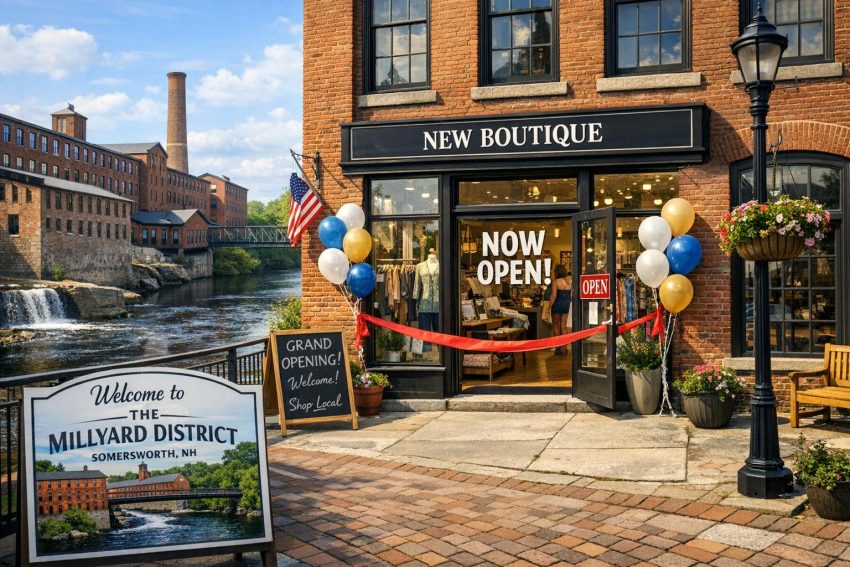
Somersworth’s Millyard District isn’t the kind of shopping area that lives and dies on one giant “main street” corridor. It works more like a small-town commercial neighborhood that happens to sit inside old mill buildings—brick walls, tall ceilings, and all. If you’re thinking about opening a retail store here, the plan has to match the reality: steady local traffic, gradual revitalization, car-friendly access, and a market that tends to reward useful, distinctive businesses.
This guide breaks down what the Millyard District is, who shops there, what you need to check before signing a lease, and how to build a retail concept that fits the area rather than just “hoping it works out.”
Understanding the Millyard District in Somersworth
The Millyard District in Somersworth, New Hampshire, traces its identity to 19th-century industrial use along the Salmon Falls River. The area grew around textile mills, and the built environment still reflects that history—older masonry, large commercial volumes, and building layouts that were designed for production, not retail.
When manufacturing declined, many mill-era properties shifted into mixed occupancy. Some spaces stayed vacant for stretches; others carried on as small offices, light industrial uses, or partial redevelopment. In more recent years, local momentum has pushed the district toward a mixed-use direction, with retail and service storefronts intended to sit alongside residential units and small commercial activity.
For a prospective retailer, the practical takeaway is simple: you’re entering a district that’s still growing into itself. That can be good. It also means you should expect uneven foot traffic patterns and a wider mix of renter and owner activity than you’d see in a fully mature commercial hub.
What kind of shopping demand fits the district?
The Millyard District tends to attract residents, visitors from nearby communities, and people who will happily drive a bit to support a locally owned store. It’s not typically a “regional destination mall” situation, so categories that rely on sheer volume (think massive entertainment anchors or big-box models) usually face a tougher lift.
Independent retail often matches the district’s practical vibe: specialty products, smaller service-based storefronts, and businesses that offer something a customer can’t easily get anywhere else on the same day.
Why the historic buildings matter
Retailers often talk about charm as if it’s free. Sometimes it is—but not always. Mill buildings come with layout quirks (steps, old mechanical runs, column placement), and modernization can be a cost center. Still, the same older architecture can help a store stand out without buying flashy signage budgets.
In other words: you can’t ignore the building, but you also shouldn’t automatically treat it like a problem that will only cost you money. It’s both. Plan accordingly.
Demographics and Market Characteristics
Somersworth’s population sits in the low tens of thousands—roughly around 12,000 residents. The Millyard District benefits from customer spillover from nearby cities such as Dover and Rochester, plus households in parts of southern Maine that will cross state lines for convenient errands when traffic and parking work out.
Because the district is closer to residential neighborhoods than many commuter-only commercial zones, it tends to attract customers who shop with intent. They’re not just wandering for the sake of it—they’re looking for a store that solves a small problem quickly, offers a preferred product, or provides a service they planned to do anyway.
Income levels and price sensitivity
Median household incomes in the area are generally moderate compared to the statewide average. That doesn’t mean customers are bargain-only, but it does mean your pricing and your product mix should make sense without requiring constant justifications.
Price sensitivity should influence both what you sell and how you sell it. If your store leans into premium pricing, you’ll need a clear reason customers should pay more: better quality, hard-to-find inventory, local sourcing, strong expertise, or a genuinely convenient experience.
Families, retirees, and working professionals
The district’s customer base typically includes families with ongoing “run-the-house” purchasing needs, working professionals who want efficiency after work, and retirees who value stores that feel familiar and predictable.
That mix affects everything from payment options to hours of operation. For example, a retailer that closes early every day without a clear rationale may lose some repeat business from customers who plan errands around predictable schedules.
Seasonality and foot traffic reality
Somersworth doesn’t have the summer-tourism intensity of coastal communities. Still, warmer months contribute extra activity—especially when local events bring people into or near the district. Winter weather can reduce walk-in traffic and make short trips more common (grab-and-go decisions instead of leisurely browsing).
From a business standpoint, seasonality means you should plan for:
- Smaller impulse purchases in winter, unless you offer quick “in-and-out” convenience.
- Online sales and pickup options that keep revenue stable when weather discourages errands.
- Promotions that match the season (not just generic “sale all year” messaging).
It’s not glamorous planning, but it keeps the lights on.
Zoning and Regulatory Considerations
Before you sign anything, you need to confirm what a parcel actually allows. Zoning in Somersworth is administered by the city, and permitted uses can vary by district and specific property. Retail is often supported, but the details matter—especially if you plan to renovate, change storefront frontage, or use a mill building with existing constraints.
What to verify with local zoning staff
When you talk with the City of Somersworth planning office, don’t just ask “Can I open a store?” Ask the practical version: what’s allowed right now, what would require a permit, and what would count as a substantial change to the building.
Important items usually include:
- Permitted use category for your business type.
- Signage rules (size, placement, lighting, and whether you can modify existing signs).
- Parking expectations and any required parking ratios.
- Hours of operation restrictions, if any.
- Outdoor storage rules, if your operations need it.
Older mill structures also introduce building code and accessibility requirements that can’t be ignored. Modern fire safety, ADA accessibility, ventilation, and electrical upgrades are common topics during renovation planning.
Permits and business registration basics
In addition to local permits, you typically need standard business registration with New Hampshire as well as local occupancy permissions before opening. If you plan to sell food, beverages, or prepared items, then health licensing becomes a separate compliance track.
It’s worth starting these steps early. Renovations and inspections can shift timelines, and a surprise delay is never friendly when staff are already hired.
Commercial Real Estate and Leasing
Commercial space in the Millyard District varies—some units are inside renovated mill buildings with attractive architectural features; others are in older condition, requiring careful assessment. Many retail candidates are drawn to the high ceilings and brick-and-timber look. Those features can reduce the amount you spend on aesthetics, but they can also create layout challenges depending on your retail concept.
Lease rates and cost beyond rent
Somersworth’s lease economics are often more favorable than larger Seacoast markets. This is one reason entrepreneurs consider the area. However, the total occupancy cost isn’t just monthly rent.
You’ll want to budget for:
- Utilities (especially heating and electricity).
- Insurance requirements for retail operations and inventory.
- CAM or common area maintenance charges, where applicable.
- Maintenance responsibilities tied to your specific lease terms.
Make sure you understand which costs are included and which are passed through. In older buildings, “routine” repairs can be less routine.
Lease terms that matter in older districts
When negotiating, pay attention to terms related to signage rights, exterior modifications, and shared parking agreements. Parking availability can be a deal-breaker for impulse-driven retail, because customers decide quickly whether they’ll bother.
Also clarify how the landlord manages exterior spaces and snow removal. In winter, parking access and safe walkways affect repeat business. It’s the kind of thing customers don’t always notice—until it’s done poorly, then they notice everything.
Hidden traps: build-out responsibilities
Many mill conversions require leaseholders to cover a portion of build-out or improvements. That’s normal, but you need a clear breakdown of what’s required for occupancy and what upgrades you can reasonably phase in.
Ask for:
- Any recent building inspection or compliance reports available.
- Information about HVAC capacity and electrical capability.
- Estimated timelines for landlord-required work versus tenant-required work.
- Whether you can make changes to the space before permits are final.
In short: treat the lease as an operational document, not just a payment schedule.
Infrastructure and Accessibility
Access matters more in smaller districts than people expect. The Millyard District is reachable via Route 236 and connects to regional highways that serve both New Hampshire and parts of southern Maine. Most customers will arrive by car, and that shapes how your storefront and parking experience should work.
Public transportation and the “car-first” pattern
Public transportation options are limited compared to metropolitan areas. So the district tends to rely on drivers and short shopping trips. That means your signage visibility from the road and your ability to guide customers into parking become practical marketing tools.
Pedestrian traffic patterns
Pedestrian foot traffic may increase over time as redevelopment adds more apartments and businesses within walking distance. Still, you shouldn’t start with the assumption that foot traffic will automatically be strong every day.
Some retailers get more from scheduled events than from typical weekday mornings. Others do better after work hours. Analyze your likely customer routine and then confirm with observation: which door gets used most, when the parking lot fills, and whether customers park once and walk between nearby businesses.
Weather, lighting, and winter visibility
Winter weather in New Hampshire changes what “accessible” means. A customer who can reach your parking lot and walkways safely is more likely to return. Poor lighting and icy entry paths reduce trust and increase friction.
Set up lighting early enough for inspection and testing. Consider whether your outside lighting will remain functional during storms (not just during clear evenings).
Retail Concepts Suitable for the District
The Millyard District’s tenant mix tends to favor independently run stores with a specific point of view. The district often supports businesses that offer products tied to everyday life (not just “nice-to-have”), along with service formats that help customers solve tasks locally.
That’s why the following store types commonly fit:
Specialty and boutique retail
Concepts like boutique clothing, curated gifts, bookstores, or craft-focused retail can work well when the inventory feels intentional. Customers in a smaller market notice when a store feels like it could be anywhere. They also notice when it clearly serves a local preference or fills a missing category.
Specialty food and beverage
Food retail can perform when it’s more than a generic convenience approach. Niche groceries, specialty ingredients, bakeries, coffee concepts, and prepared food offerings can create repeat visits—especially when paired with in-store events or tastings.
If you’re pursuing food, pay extra attention to permitting and facility requirements. Older buildings can require kitchen-specific upgrades depending on the model you choose.
Wellness and community services
Wellness-related stores, retail services tied to health (supplements, mobility aids, wellness apparel), and appointment-based service storefronts can create reliable demand, especially if you emphasize helpful staff and correct product matching.
Business types that may struggle
Big-format retailers relying on high-volume foot traffic may struggle unless they bring their own draw. A store can be attractive and still not generate the traffic it needs if customers don’t treat it as part of their routine.
That’s why it’s often better to focus on categories that are “mission-based” for local customers: buying something they planned to buy, or getting a service they prefer to handle nearby.
Local demand analysis that doesn’t lie
Because the district is still developing, some categories may be underserved at the moment. The risk is that a perceived gap turns out to be seasonal or too small to support your price point.
Conducting a localized demand analysis is crucial before determining product mix.
A demand analysis doesn’t have to be fancy. You can combine:
- Simple survey questions to local residents about shopping habits.
- Observation of nearby competitors: what sells, what sits on shelves, which products are out of stock.
- Assessment of store hours and repeat patterns, including weekends.
- Review of online search behavior for local terms relevant to your category.
When the numbers and the foot traffic story disagree, assume the story is more honest. The market decides, not the spreadsheet.
Online ordering with in-store pickup
Even with a physical store, customers increasingly want an “easy mode.” Online ordering with in-store pickup can help you survive winter slowdowns. It also gives you a way to test inventory without buying the entire shelf in advance.
Done right, this model works for both customers and staff. Customers feel supported; your team gets structured demand rather than guessing.
Financial Planning and Funding Resources
Retail opening costs extend beyond inventory. You’ll need to cover lease deposits, leasehold improvements, initial inventory, staffing, marketing, insurance, and possibly specialized equipment or build-out required by your business type.
Build-out costs in older mill buildings
Historic or older commercial spaces can be costlier to update than modern boxes. Not always, but frequently enough that you should plan with a conservative budget.
Common cost drivers include:
- Electrical upgrades for lighting, POS systems, refrigeration (if applicable), and security.
- Plumbing changes if your concept includes sinks, washing areas, or prepared food.
- Fire suppression systems or fire alarm work, depending on the building’s existing configuration.
- Accessibility improvements, including entrances and restrooms.
- Insulation and HVAC upgrades for energy efficiency.
If you’re not sure what’s required, ask for a vendor walkthrough early. Even a preliminary estimate can prevent unpleasant surprises.
Funding options for Somersworth entrepreneurs
Many retailers use a blend of savings, bank financing, and possibly government-backed programs. In New Hampshire, you may see involvement from institutions that work with small-business lending, along with the federal Small Business Administration (SBA) loan programs.
Local economic development efforts can also offer incentives in some cases, especially for historic building improvements or façade upgrades. The availability changes, so treat incentives as something you check—not something you assume.
Revenue projections that don’t assume miracles
During the first year, revenue tends to be steadier than you’d hope and slower than you’d brag about. Revitalization can improve demand gradually, so your forecast should assume a ramp rather than instant volume.
Maintain working capital for at least six to twelve months of operation. That buffer gives you time to adjust staffing, inventory ordering, and marketing without doing the “sell everything, panic-buy nothing” cycle.
| Budget Area | What to Plan For | Why It Surprises New Owners |
|---|---|---|
| Leasehold improvements | Permits, contractor work, code upgrades | Older buildings often need scope clarification |
| Inventory and reorder timing | Initial stock + safe reorder cadence | Demand takes time to stabilize |
| Insurance | General liability, property, workers’ comp | Premiums vary based on business type |
| Marketing | Launch promos + ongoing local outreach | Opening marketing isn’t the same as retention |
Marketing and Community Integration
Marketing in the Millyard District works best when it fits the community’s rhythm. People are more likely to support local businesses that feel part of daily life: they run events, collaborate with neighbors, and show up when the district needs them.
Digital marketing that stays local
Social media and local search visibility still matter, but the goal should be simple: make it easy for someone to understand what you sell, when you’re open, and why you’re worth a quick trip.
Local radius targeting can work for retail if your offer is clear and your business hours are consistent. You’re not trying to go viral; you’re trying to show up in the decision moments.
Local events and partnerships
Farmers markets, seasonal festivals, art walks, and civic events can bring in customers who might not otherwise find your storefront. Retailers who do well often treat these as relationship-building tools, not just one-day sales opportunities.
Cross-promotion with other shop owners helps too. If another store offers services that complement yours, it’s easier for both businesses to point customers in useful directions.
Brand consistency
In smaller markets, branding isn’t about fancy design. It’s about recognition and trust. Customers return when they know what to expect.
Clear and consistent branding matters because people don’t always have time to decipher a new storefront every week.
Renovation and Store Design Considerations
Mill buildings offer an aesthetic advantage, but store design still has to solve real problems: heating, lighting, customer flow, checkout placement, and accessibility.
Heating, insulation, and lighting
New Hampshire winters can be harsh. If you open in an older structure without adequate insulation and heating capacity, operating costs can creep up fast. The building may look like it’s ready for business, but once you add modern retail lighting and customer load, the HVAC system needs to handle the new reality.
Energy-efficient systems and insulation upgrades often pay back over time through reduced heating costs and improved comfort.
ADA compliance and accessibility
ADA compliance is mandatory. In practice, that means accessible entrances, restrooms where required, and clear pathways inside. With older buildings, accessibility improvements may take more work—ramps, doorway adjustments, restroom reconfiguration, and circulation changes are common.
Plan for this early. Accessibility work rarely stays cheap once you’re deep into finishing and decoration.
Layout: flow beats floor space
The interior layout should support how customers shop. Wider aisles, visible product sections, and intuitive signage reduce friction. In older buildings, column placement and unusual ceiling geometry can mess with sightlines, so the design should actively solve those issues rather than pretending they aren’t there.
If you sell specialty or higher-value items, security and inventory management become a design consideration, not only an operational one. Consider storage access, display placement, and how staff can safely monitor the floor without feeling like referees for a contact sport.
Staffing and Workforce Factors
Retail staffing is often overlooked during planning, but it becomes the difference between a store that “feels good” and one that fails quietly.
Labor availability in the region
Somersworth and surrounding communities provide a local labor pool. You can hire part-time and full-time staff, but you should expect competition for workers, especially from larger employers in the region.
Wages must comply with New Hampshire minimum wage and federal regulations, plus any additional requirements for overtime and worker protections.
Training and role clarity
In small retail, staff often do multiple jobs: customer service, merchandising, inventory restocking, order processing, and basic maintenance tasks. That means training needs to be practical and consistent.
Even a “small store” benefits from written procedures: how to open and close, how to handle returns, how to track shrink risk, and what the store standard is for customer interaction.
Scheduling that matches store traffic
Predictable scheduling helps retention and supports consistent customer experience. For example, if your busiest periods cluster around evenings and weekends, then staffing should align with that reality instead of leaving the floor thin when customers actually show up.
Risk Assessment and Long-Term Outlook
Retail in an evolving district can be rewarding, but it’s not risk-free. The Millyard District’s redevelopment direction suggests momentum—more residences, more tenants, and a slow improvement in local demand. Still, retail remains sensitive to economic shifts and to construction or renovation timelines that affect neighbor businesses and access.
Traffic can rise slowly
One of the most common planning mistakes is assuming foot traffic will “catch up” immediately once a store opens. In practice, a district can improve gradually, and new retail demand often grows in steps.
Plan for ramp-up. If you set inventory too deep before you understand how customers buy, you can end up with cash tied up in slow-moving items.
Old buildings create an operational risk profile
Older mill properties can bring maintenance surprises: roof work, heating system issues, plumbing problems, or electrical adjustments that weren’t visible during initial viewing. Your lease terms may allocate responsibility differently, but the operational impact is usually still on you.
Contingency planning helps. Keep a reserve for unexpected repairs and schedule vendor check-ins early in ownership, not after something breaks.
Diversify revenue so winter doesn’t wreck your month
Revenue diversification can include online sales, local pickup options, and structured in-store events that create predictable traffic. When weather reduces walk-ins, alternative ordering channels can smooth the revenue curve.
It’s not a guarantee, but it reduces volatility.
Engagement with Local Government and Development Initiatives
Somersworth has been actively involved in revitalizing the downtown and Millyard areas. If you want your store to fit into that direction, you should stay informed about municipal projects that could affect access, signage, parking, or future development nearby.
How to stay informed without drowning in paperwork
Attending public meetings or joining relevant business discussions can help you learn about zoning amendments, grant programs, and infrastructure improvements. You don’t need to become a part-time bureaucrat, but showing up occasionally can help you avoid surprises.
If there’s a schedule for street work, lighting improvements, or changes to traffic patterns, business owners who know early can adapt marketing plans and operational expectations.
Why proactive communication helps
When you communicate early with city staff, you reduce the risk of coming to compliance issues late in your timeline. Even if the answer doesn’t change right away, you gain clarity on what standards you’ll need to meet during renovations.
Putting It Together: a practical opening approach
Most new retailers run into predictable problems that could have been avoided with better sequencing. Here’s a practical way to think about the process for the Millyard District.
Step 1: confirm zoning and build-out responsibilities
Get answers in writing or at least validated by the right staff members. Ask about signage, permits, occupancy requirements, and any historic or code-related upgrade expectations tied to your specific space.
Step 2: model your first-year cash flow conservatively
Assume slower ramp-up. Include the cost of build-outs, ongoing maintenance, seasonal marketing, and working capital needs. If you plan for the best case and ignore the base case, you’ll feel the stress sooner than you’d like.
Step 3: design the storefront for repeat visits
Customers don’t just buy once; they decide if a store works for future errands. Your design should support browsing and quick decisions, with signage and layout that reduce hesitation.
Step 4: build local marketing habits, not one-time launches
Launch promotions are helpful, but they’re not the whole strategy. Participate in district events, collaborate with neighbors, and keep your online information updated so customers can plan their next visit without guesswork.
Step 5: plan for winter from day one
Lighting, weather-safe entries, clear signage, and ordering options should all be part of your opening plan rather than last-minute “we’ll deal with it” intentions.
Conclusion
Opening a retail store in Somersworth’s Millyard District takes more than enthusiasm and good inventory. The district’s mill-history identity, mixed-use redevelopment, moderate local purchasing power, and car-first access shape what will and won’t work.
The upside is straightforward: relatively accessible commercial space, strong community support for independent businesses, and a district that’s actively growing. The downside is also straightforward: demand may ramp gradually, older building renovations can shift timelines, and winter can reduce walk-in traffic unless you plan thoughtfully.
Thorough preparation, realistic financial planning, and consistent community integration are what separate a store that’s “open” from a store that lasts. If your concept matches local demand and your execution respects the building and the season, the Millyard District can be a solid place to build a sustainable retail foothold.