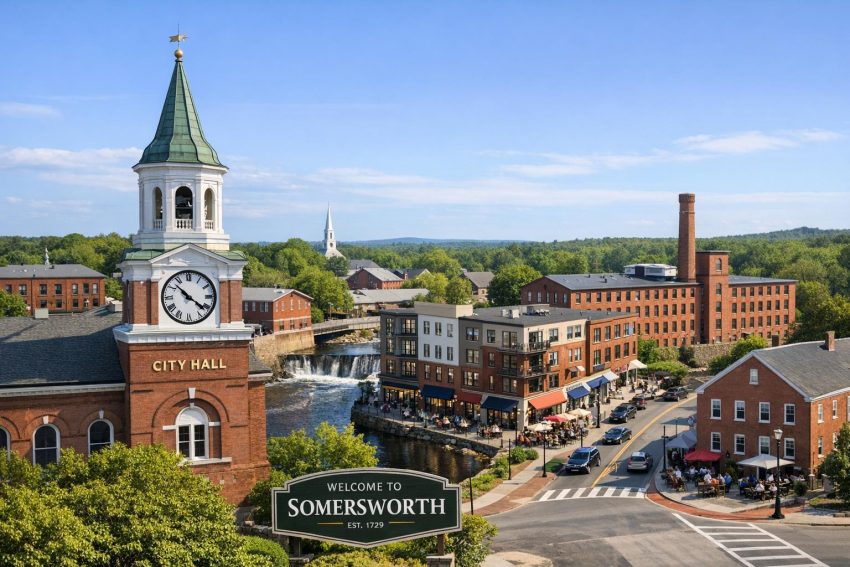
Somersworth, NH sits in a part of New Hampshire where “growth” is real, but it’s not the kind that bulldozes everything in sight. It’s a small city in southeastern New Hampshire, positioned between larger employment and retail centers, and it has been getting more attention from planners and developers looking for mixed-use projects that don’t feel copied from somewhere else. If you’re the sort of person who reads zoning maps for fun (no judgment), the local mix of historic buildings, walkable blocks, and evolving policy makes Somersworth an interesting case.
This article breaks down the practical reasons mixed-use development is gaining traction there—starting with the geography, then working through the buildings, utilities, land options, market demand, and what “supportive” municipal policy actually means in this context.
Somersworth’s Position in the Seacoast Market
Somersworth is part of the Seacoast region, close enough to major population centers to benefit from their economic gravity, but far enough away to avoid some of the “sky-high land costs” problems that show up in the bigger coastal hubs.
Tri-city demand effects
Somersworth sits near Dover and Rochester, and that matters because retail and housing demand usually don’t respect city borders. People shop where they work, or close to where they pass through on the way to somewhere else. A mixed-use district in Somersworth can draw customers from neighboring communities without needing a brand-new travel pattern to form.
When a town is inside a shared labor and consumer market, the math for mixed-use tends to look better. Ground-floor retail has a steadier customer base, and residential demand benefits from the ability to live locally while still reaching job centers within a short commute.
Road access and commutes that don’t kill the plan
Route 16 and proximity to Interstate 95 provide connections to broader markets, including regional employment corridors that run toward larger coastal and inland areas. That kind of access is relevant for mixed-use because it supports two buyer profiles at the same time:
- Residents who want services nearby but still commute for work.
- Businesses that need customers who can visit by car and also customers who walk or bike within a district.
In many “mixed-use” plans, the walkability target gets all the attention, but access by road is still what keeps vacancy rates from getting dramatic. Somersworth has enough connectivity to support both.
Why relative affordability matters
In areas where land is scarce and expensive, mixed-use projects can become financially fragile. Premium valuations force developers to build bigger or take on more risk than the market can reliably absorb.
Somersworth typically offers a different cost environment. It’s not “cheap everywhere,” but it often allows more flexibility for developers who need to assemble parcels, rehabilitate structures, or work with sites that require upgrades. For mixed-use, that flexibility can be the difference between a theoretical plan and a buildable one.
Historic Mill Buildings and the Reality of Adaptive Reuse
Somersworth’s industrial history didn’t just shape its economy; it shaped its street pattern, building stock, and downtown character. Mixed-use development often performs best where the built environment already supports density. Somersworth has that foundation.
Compact urban fabric that already supports walking
Mill towns tend to grow in fairly compact patterns because factories, housing, and services formed together. In Somersworth, older brick mill buildings sit near downtown-adjacent corridors, and the block structure is generally conducive to shorter walking distances.
Mixed-use districts rely on something simple: you don’t want people to feel forced to drive just to reach everyday needs. When the physical layout already approximates that approach, the development strategy becomes more believable.
Adaptive reuse as a practical development strategy
Historic industrial buildings offer a set of characteristics that mixed-use developers like:
- Large volumes that can be converted into apartments, office space, and retail at the same time.
- Solid construction approaches that often survive structural reconfigurations better than newer, lighter builds.
- Floor-to-ceiling heights and flexible floor plates that make mixed interior layouts easier.
A mill conversion doesn’t have to be overly clever to work. Common configurations include residential units above, with ground-floor spaces for local shops, services, cafés, or small professional offices. Sometimes those uses can live in the same building without requiring an extreme redesign of the structure.
There’s also a marketing and community angle: renovated historic buildings tend to attract tenants who care about character, and local businesses often like spaces with a distinct look rather than another blank-box storefront.
Why this matters for tenant mix
Mixed-use succeeds when tenants don’t all require different customer behavior. If an upper-floor apartment building and a ground-floor retail storefront share the same address, the retail tenant gains steady “resident foot traffic,” not just random passersby.
Somersworth’s mill-era building stock helps create that shared address effect. It’s not the only factor, but it makes tenant mix easier to plan.
Zoning and Planning: What “Supportive Policy” Looks Like
Municipal policy doesn’t automatically create a market, but it can remove friction. In permitting terms, friction is cost, time, and uncertainty—three things developers generally don’t love.
Mixed-use district frameworks
When Somersworth updates its zoning or planning guidance toward higher-density and mixed-use, the benefit shows up in day-to-day approval decisions. Mixed-use zoning can allow combinations like:
- Residential above ground-floor retail
- Retail and office in the same district
- Compatible civic or community uses near commercial corridors
That flexibility reduces the number of “workarounds” developers need. Fewer variances or fewer sequential approvals usually means faster timelines, which affects financing terms and carrying costs.
Form-based thinking and clearer site design rules
Many towns now use form-based code concepts or overlay districts that specify things like height transitions, building placement, and pedestrian-oriented design standards. When a city gives clearer guidance on setbacks, transparency requirements at street level, and frontage design, developers can price the project with fewer unknowns.
Predictability matters in mixed-use because the ground floor is where design becomes complicated. Signs, setbacks, entrances, parking layout, safety lighting, and accessibility all have to line up. Clear rules reduce the risk of redesign cycles late in the process.
Public support beyond zoning text
Economic development tools can also improve feasibility. Even modest public investment—streetscape upgrades, sidewalk improvements, better lighting, traffic calming, or utility improvements—can make a mixed-use district more attractive to both tenants and customers.
In smaller cities, those improvements can have outsized impact because the baseline condition of downtown streets matters more than it does in places where infrastructure already feels “done.”
Housing Demand: Who’s Buying or Renting Mixed-Use Units
Mixed-use development lives or dies by housing demand. Somersworth benefits from broader New Hampshire trends and regional affordability dynamics.
Seacoast rental and smaller-unit demand
In the Seacoast region, demand has been leaning toward rental housing and smaller ownership units. When nearby cities get more expensive, households often look for communities that still offer access to jobs and services without the same pricing pressure.
Mixed-use projects often provide that in a practical format: apartment units above active retail streets, with a walkable “daily needs” pattern.
Mixed-use housing fits multiple household types
Mixed-use addresses more than one tenant profile:
- Young professionals who want an easy commute and nearby food options.
- Smaller households that don’t need large space but appreciate convenience.
- Older adults who may downsize and prefer services close by.
Even if you’re not a demographics nerd, you can see the logic. People don’t want to haul groceries across town if they can avoid it. Mixed-use districts give you fewer steps between “home” and “things you need.”
Infill scale and absorption pace
Somersworth’s size makes certain project scales workable. It’s usually better suited to mid-scale developments—large enough to create a cohesive district, but not so large that the town has to swallow everything at once.
That matters for absorption. A phased approach can help stabilize leasing and reduce developer risk. If one component performs well (for example, apartments leasing faster than retail), the project can adjust rather than forcing every tenant space to fill immediately.
Economic Diversification and Why Small Businesses Matter
Retail and office tenants aren’t interchangeable. A mixed-use building that works in a major city might fail in a small city if it targets the wrong business types. Somersworth’s economic structure and regional customer base support a tenant mix that leans local and neighborhood-serving.
Small business presence and flexible commercial space
Somersworth has a working mix of service providers, local shops, and smaller-scale businesses. Mixed-use development can complement that environment by offering commercial space that matches how small businesses rent: smaller footprints, flexible layouts, and lease terms that don’t assume every tenant will look like a national chain.
Ground-floor retail tends to do best when it’s aligned with what residents actually use often enough. Think daily conveniences rather than “someday novelty.”
Retail that typically fits mixed-use corridors
Neighborhood retail in mixed-use districts often includes categories like:
- Food and beverage cafés
- Personal services (hair, fitness, and similar)
- Specialty or convenience grocery options
- Professional offices and small service businesses
The tri-city market effect helps, because retail tenants can draw both local residents and nearby visitors. But the district still needs to feel useful to people who live there day-to-day.
Office demand in smaller spaces
Office space within mixed-use buildings can attract remote workers, freelancers, and small firms. As work patterns change, smaller office footprints with easy access to amenities can be more competitive than large, expensive suites.
If the building includes shared amenities—conference rooms, lobbies that don’t feel like a waiting room, and common spaces—then smaller office tenants gain value even without major corporate branding.
Utilities, Street Design, and the Not-So-Glamorous Part
People talk about renderings a lot. Engineers and public works staff talk about pipes and capacity, which is slightly less exciting, but also slightly more important.
Municipal services reduce development complexity
Somersworth’s urban core is served by established infrastructure systems for water, sewer, and electricity. Compared to development in areas without municipal utilities, that can reduce early costs and simplify permitting.
Mixed-use projects require coordination because they combine residential and commercial uses. That affects plumbing loads, stormwater management, and sometimes energy or fire-suppression systems. Having municipal services in the serviced districts tends to reduce the “unknowns” that stretch project schedules.
Street network that supports walkable movement
Older cities often have grid-influenced street networks. Somersworth’s layout in parts of the downtown-adjacent area supports walking and short trips between blocks.
Sidewalk presence, crosswalk patterns, and building frontage placement determine whether the “walkability” idea is just a slogan or actually a habit. If streets have sidewalks and if building entrances align with the public realm, mixed-use becomes more credible.
Targeted transportation improvements can boost performance
Even when a street works, improvements can raise demand. Examples include traffic calming that keeps vehicle speeds reasonable, better signage that reduces confusion for first-time visitors, and bicycle facilities that make commuting less annoying.
In smaller cities, even incremental improvements can noticeably change the feel of a corridor. You might not get a whole highway redesign, but you can get a street that people actually want to cross.
Redevelopment Sites: Where Mixed-Use Projects Can Actually Land
A city can talk about mixed-use all day, but projects still need sites. Somersworth has redevelopment options that fit different development approaches.
Underutilized parcels and surface parking
Some of the most common mixed-use catalysts in small and mid-sized cities are underutilized parcels—especially surface parking lots near downtown. These sites often have land value that looks “stuck” because the parking use is temporary.
When those parcels are assembled or redeveloped, they can create contiguous building footprints that support multiple uses at the right street frontage.
Former industrial properties and brownfield considerations
Brownfield sites can work, but they require environmental assessment and, sometimes, remediation. Developers who handle that process carefully may find acquisition prices more favorable than for already-entitled, fully improved parcels.
The tradeoff is time and compliance—environmental work can shift the schedule. That’s where programs and guidance from state or federal support can improve feasibility. Developers often factor this into underwriting early so surprises don’t wreck the financing plan.
Infill redevelopment in existing neighborhoods
Somersworth also has opportunities for infill: vacant lots, older commercial buildings with underperforming uses, and small parcels that can be assembled into workable development sites.
Infill tends to keep projects more in scale with the surrounding context. When building heights stay within a moderate range and street-level retail fronts remain true to the existing pattern, the project integrates more smoothly and tends to face fewer objections.
Quality of Life: Amenities That Strengthen Tenant and Buyer Interest
Mixed-use development isn’t only about zoning. People choose neighborhoods for daily comfort: parks, walkable blocks, community services, and access to outdoor activities. Somersworth has natural advantages that can support that decision-making.
Salmon Falls River and the city’s geographic identity
The Salmon Falls River connects civic identity to place. For mixed-use districts, proximity to water features and green spaces can increase desirability. It doesn’t automatically fill apartments, but it helps create a neighborhood reputation that residents recognize as more than just “somewhere near work.”
Regional outdoor access
In the broader Seacoast region, beaches, conservation lands, and cultural institutions contribute to a strong livability score. People working in nearby employment centers may prefer housing in communities that offer both affordability and access to weekend activities.
Mixed-use can strengthen that by putting housing near everyday services, so residents use nearby outdoor time instead of spending their weekends running errands across town.
Civic institutions that make mixed-use districts feel “complete”
Libraries, community centers, and schools don’t sound like developer talking points, but they matter. When civic functions sit near mixed-use retail and housing, the district becomes part of daily routines rather than an isolated “project block.”
Sometimes the best-performing mixed-use districts are the ones that create small public gathering spaces—plazas, widened sidewalks, or outdoor seating zones—that support community use.
Project Scale and Competition: A Practical Advantage
Competition and project scale are related. In massive metro areas, developers face intense competition, large land costs, and constant pressure for the newest concept. In smaller cities like Somersworth, the playbook can be more straightforward.
Less saturated conditions
Because Somersworth is not a top-tier global development hub, it tends to see fewer competing large mixed-use projects. That can benefit new entrants that build well and align with local needs.
The district’s success still depends on execution, but it may not face the level of saturation that appears in larger markets where renters have many more choices.
Building size that matches local absorption
For mixed-use, building scale should match local demand patterns. In Somersworth, three- to five-story buildings with street-level commercial and upper-level housing can align with the city’s architectural context and market pace.
Large high-rise models often don’t fit everywhere, and the cost structure can force rent levels that the local market can’t support. Mid-rise approaches are often easier to finance and easier for neighborhoods to accept.
Phasing reduces financial stress
Mixed-use projects can be phased—new residential units first, or retail construction synchronized with the leasing rate. Phasing doesn’t eliminate risk, but it can limit the “all-in at once” problem that hits overstretched projects.
In a smaller market, where tenant absorption matters more, phasing tends to be the sensible route.
Regional Growth Trends and Long-Term Demand Logic
A single project can succeed for short-term reasons. Long-term success depends on broader demand trends: population movement, job development, and affordability shifts across neighboring communities.
Boston-to-Portland corridor effects
The broader corridor between large employment centers and coastal nodes suggests continued interest in communities that offer reasonable housing costs with access to regional work.
Somersworth is smaller than the primary employment hubs, but it sits within the orbit of commuting options. That supports stable housing demand over time, especially for residents who can’t or don’t want to live right inside the most expensive markets.
Downtown stability and tax base considerations
Municipal leaders generally prefer downtown redevelopment that supports a sustainable tax base. Mixed-use contributions to property tax can come from both residential and commercial components.
Also, compact development patterns often lower per-unit infrastructure costs compared with sprawling suburban growth. For cities, that matters because budgets don’t enjoy surprises.
Demand for walkable neighborhoods keeps showing up
Even when people buy farther out, many still prefer walkable access to daily services. Mixed-use districts reduce friction in everyday life, and that tends to hold consistent demand characteristics.
As remote and hybrid work patterns evolve, the idea of “live near errands and nearby services” keeps appeal because it reduces dependence on long trips.
Common Challenges Somersworth Developers Should Expect
No development story is perfect, and Somersworth isn’t exempt. Mixed-use can work well here, but developers should expect a few typical hurdles.
Tenant mix can swing if the plan targets the wrong customer
If retail space is marketed to businesses that don’t match neighborhood spending patterns, leasing can lag. Mixed-use retail needs to fit local and commuter behavior, not only what looks good in a brochure.
Parking requirements need careful calibration
Parking policies in mixed-use districts often walk a tightrope between accommodating visitors and avoiding an oversupply of surface lots. The design can’t assume everyone will walk, and it can’t assume everyone will drive either.
Smart parking strategies—shared parking, structured parking where appropriate, or reduced parking ratios near strong transit/walk corridors—can help, but they need local policy alignment.
Environmental work can stretch timelines
For brownfield or older industrial redevelopment, environmental assessment and remediation may extend schedules. Developers can reduce surprise by budgeting early, conducting phase-appropriate testing, and aligning with regulatory expectations from day one.
Old building conversions require extra patience
Historic adaptive reuse may look simpler on paper than it is in practice. The building might need upgrades for fire safety, accessibility, structural reinforcement, or modern mechanical systems. None of that is unusual, but it does need accurate budgeting and clear sequencing.
If you’re building new systems into old shells, plan for surprises. They’re rarely dramatic; they’re just annoying.
What a “Good” Mixed-Use Project Looks Like in Somersworth
Mixed-use projects can fail for reasons that aren’t obvious from renderings. The better projects share a handful of practical traits that translate across markets.
Street-level spaces that people actually enter
Ground-floor commercial tenants need visibility, accessible entrances, and storefront design that feels like part of the street rather than the back side of a building.
In walkable districts, the front door is not a detail. It’s where leasing success starts.
Residential that’s not isolated from the street
Units can be private and comfortable, but the building design should still connect residents to the street. That might mean active lobbies, clear pedestrian paths, and amenities that encourage use of the surrounding district.
Design that fits the existing block rhythm
Somersworth’s historic patterns—entrance placement, block alignment, and general massing—support moderate-scale redevelopment. When a project respects those patterns, it tends to integrate more smoothly and face fewer issues with neighbors.
Parking and access that match the neighborhood
Parking layouts that minimize visibility of cars and keep pedestrian routes safe are often a win. The goal is not to eliminate parking; the goal is to keep it from becoming the dominant feature of the site.
Bottom-Line Feasibility: Why Somersworth Makes Sense for Mixed-Use
Somersworth has the components that usually matter for mixed-use development: a location inside a broader regional market, a historic building base suited to adaptive reuse, zoning and planning moving toward mixed-use possibilities, and a practical mix of housing demand and small-business needs.
It also has the kind of site flexibility that smaller cities need. Developers can work with underutilized parcels, infill locations, and industrial properties that can be repositioned—sometimes with the help of incentives or remediation support where applicable.
Finally, Somersworth’s mid-scale development potential fits how markets actually absorb housing and retail. Projects don’t need to be massive to be meaningful. A few well-placed blocks of housing over active streets can shift the feel of downtown, strengthen local businesses, and add housing choices without forcing the city into a “bigger than it needs to be” strategy.
If you’re evaluating mixed-use investment in southeastern New Hampshire, Somersworth is worth serious attention—not because it’s a magic answer, but because the pieces fit together in a way that’s often harder to find elsewhere.