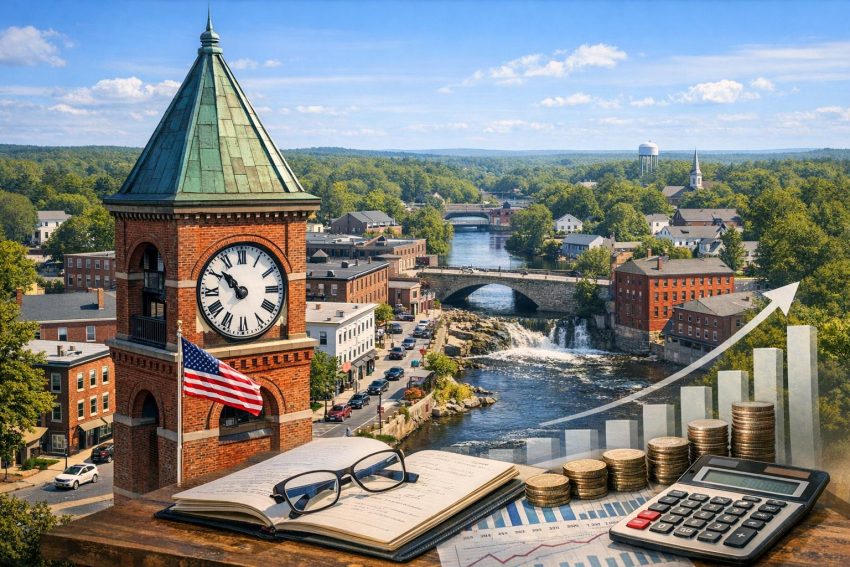
Somersworth, New Hampshire sits in the not-too-big, not-too-small category that tends to get ignored in business conversations. It’s roughly a twelve-thousand-resident city, close enough to larger employers to matter, but small enough that local decisions and property upgrades can show up in the numbers. And like a lot of older U.S. towns, Somersworth has had to work through an economic pivot—from a manufacturing-and-mills identity toward something more mixed.
For investors, brokers, and business owners, that shift isn’t just local history. It’s a case study in how smaller markets change, how risk shows up, and how redevelopment can actually translate into usable commercial opportunities. If you’ve ever wondered why a “plain” city on the map can still produce solid deals (or why a “promising” one goes sideways), this kind of story is a practical starting point.
Industrial Legacy and Economic Transition
Somersworth’s industrial past is the kind you find in many parts of New England: mills clustered near water power, housing built around labor, and downtown streets shaped by foot traffic that came from factory shifts. Brick buildings remain visible reminders. They’re not symbolic decoration; they were built for work—heavy loads, high ceilings, long-term use.
The trouble starts when the market stops wanting what those buildings were designed to produce. During the twentieth century, global manufacturing changes reduced demand for certain domestic production models. The result is a pattern that repeats across the country: employment falls, storefronts thin out, and the tax base tightens.
Here’s the basic business lesson: economic concentration increases vulnerability. If a local economy depends heavily on a single employment driver, outside forces can hit hard and fast. When the jobs go away, things that looked “stable” on paper—rents, vacancy assumptions, retail demand—get tested.
How Somersworth’s economy broadened
Over time, the city’s local economy diversified. The mix grew to include healthcare services, small-scale manufacturing, retail, hospitality, and professional services. Instead of trying to reverse the old manufacturing model, Somersworth used what it already had: buildings, infrastructure, and a downtown that could support new uses.
That’s the part many redevelopment plans skip. You don’t rewind time and magically restore textile dominance. You reposition the physical inventory you already own. Former mill buildings and older downtown properties moved toward office space, residential conversions, and mixed-use configurations.
In investor terms, this is about asset repurposing: changing how a structure earns money without pretending the end-user demand stays the same every decade.
Adaptive Reuse as a Growth Strategy
Adaptive reuse is the word planners use, but the idea is pretty straightforward. You take an older building and adjust it for a modern purpose—sometimes with dramatic interior work, sometimes with careful upgrades that respect the existing structure.
In Somersworth, the renovation of historic mills and downtown real estate made room for entrepreneurs and smaller tenants who needed affordable space. In larger markets, entry costs can be brutal. In smaller cities, the economics can look friendlier: rents are lower, land costs can be less extreme, and permitting sometimes moves at a pace that doesn’t require a part-time lawyer just to schedule meetings.
That doesn’t mean it’s automatic. Historic properties can demand higher upfront costs. But they can also deliver something the market often values: character, street presence, and a sense of place that customers recognize without being asked.
The investor lens is simple: underutilized assets can become competitive advantages. If a building can perform, even with renovations, it can outcompete a new build in certain categories—especially when the alternative is basic, indistinguishable space that doesn’t create momentum.
What makes adaptive reuse work in practice
Adaptive reuse usually depends on three things lining up:
First, zoning and approvals. If the land-use code blocks the intended use, the project is stuck in limbo. Reform doesn’t have to be flashy; it just has to be consistent and understandable.
Second, financing feasibility. Rehabilitation costs can swing based on building condition, code requirements, accessibility needs, and mechanical upgrades. Investors who run the numbers early get fewer nasty surprises later.
Third, community support. Small cities are close. People talk. If the redevelopment plan looks like it ignores neighborhood needs, pushback can stall timelines. On the other hand, when stakeholders see a credible plan for parking, traffic, and long-term maintenance, approvals can move.
There’s also a copycat lesson businesses can use internally: companies often keep “legacy processes” because replacing them feels risky. Adaptive reuse is basically the real-world version of “reconfigure rather than discard.” If the structure can be safely reworked, it can still generate value.
Regional Integration and Commuter Economics
Somersworth doesn’t exist alone. It sits inside a wider employment and services region. It’s near Dover and Rochester, and within reach of Portsmouth and parts of southern Maine through commuting patterns. That matters because smaller cities often rely on a regional labor market rather than a self-contained one.
When residents commute, households earn from jobs outside the city limits. That changes retail and service demand—customers show up because their income isn’t fully tied to local employers. Meanwhile, some businesses benefit too. They can serve buyers from nearby communities while keeping operating costs lower than they would in the largest metro centers.
This is why small cities rarely function in isolation. Success depends on transportation links, employment corridors, and supply relationships that stretch beyond city borders. Even with remote work and e-commerce, the “region effect” still shows up. It just shifts from daily commuting to a combination of travel, delivery routes, and digital purchasing behavior.
What businesses should consider when choosing where to locate
If you’re deciding where to operate, a nearby commuter base can be a quiet advantage. It supports grocery demand, healthcare utilization, and basic services even when local hiring isn’t exploding.
But you also need to ask the unglamorous questions:
Does the local economy produce enough customers visiting your specific category, or are you dependent on a small number of regional employers? Are you selling to residents inside city boundaries, or are your buyers just passing through? These details change the risk profile when one major regional employer struggles.
For policymakers, the related point is straightforward: transportation improvements and broadband access aren’t “nice to have.” They’re part of keeping the local market connected to the broader economy.
Incremental Development Instead of Rapid Expansion
Somersworth’s growth trend reads like a cautious model. It hasn’t gone from zero to boom in a single decade. Instead, redevelopment appears gradually, with each phase improving or stabilizing what came before.
For business people, incremental growth often feels less dramatic but more manageable. When a city expands rapidly, infrastructure can lag behind. Property values can spike faster than wages. Service providers get overwhelmed. That’s not always fatal, but it can create accounting problems and operational chaos for tenants.
In contrast, incremental development tends to allow time for:
Demand to show itself. A retailer doesn’t open based on a marketing yearbook prediction; it opens because consistent foot traffic is emerging.
Infrastructure to catch up. Water, roads, parking, and utilities can be upgraded in phases.
Housing and services to align. Families and workers move in when there’s credible housing supply and schools and services can absorb growth.
That leads to a useful scaling concept: sustainable scaling can outperform aggressive short-term expansion, especially in markets where population growth is modest. You can expand capacity while controlling debt exposure—less “bet the ranch,” more “improve where the market already supports it.”
Role of Local Government and Policy Predictability
Small municipalities often operate differently than big cities. Decision-makers may be more accessible, and local business owners can sometimes get direct input into how zoning revisions or downtown planning play out.
In Somersworth, policy tools like downtown revitalization plans, zoning revisions, and tax-related development districts have supported redevelopment initiatives. The important detail isn’t the existence of these tools—it’s how they behave over time.
Investors and tenants usually care about predictable rules more than perfect rules. When the permitting process stays consistent, people can estimate timelines and prepare for costs. When regulations shift abruptly, projects slow down because the market’s “known unknowns” turn into “unknown unknowns.” Smaller cities may not have enough capital depth to absorb delay costs.
Transaction costs in plain language
Institutional transparency and engagement lower transaction costs. Transaction costs are the time and money spent on non-selling activities: meetings, revisions, paperwork, and uncertainty. In smaller markets, those “in between” steps can be manageable if communication is clear.
This matters because redevelopment is seldom a solo sport. Developers, lenders, contractors, city departments, and community groups all need to share enough clarity to move together.
Housing Supply and Workforce Stability
Housing is one of those topics that seems local and boring—until you’re running a business and you can’t find workers who can afford to live within reach. In many parts of New England, housing supply constraints affect both prices and availability.
Somersworth has faced ongoing discussions about balancing residential development with preservation, while also addressing rising housing costs. For employers, that balance matters because workforce availability depends on whether employees can find reasonable options in commuting distance.
When housing supply stays tight, labor shortages can limit business expansion. When housing supply improves in sensible locations, employers often see better hiring outcomes and steadier staffing.
Planning matters here:
– Multiyear construction timelines affect when new units come online.
– Zoning approvals decide what types of housing can be built.
– Commuting patterns determine whether “nearby” is actually nearby for workers.
A business evaluating expansion plans should treat housing pipelines as part of the market study, not an afterthought. If workforce stability looks shaky, revenue growth often becomes harder than the sales forecast suggests.
Small Business Networks and Local Reputation
Small cities typically don’t rely on a single corporate anchor. Employment and consumer spending often come from locally owned enterprises and small regional operators. Think restaurants, contractors, service providers, and specialty retail—businesses that depend on repeat customers and steady local demand.
Somersworth’s downtown improvements encouraged exactly that type of occupancy: not only big-box arrivals, but everyday businesses that draw people because they’re convenient, familiar, or simply worth the trip.
In tight-knit areas, reputation spreads faster than a rumor should. A consistent experience creates loyalty. A bad experience can also travel quickly through community networks—especially when owners hear customer feedback directly.
This is why trust functions as a core economic asset in small markets. “Trust” here means reliability: accurate communication, fair dealing, consistent service quality, and follow-through. Companies that invest in community connections—local sponsorships, school partnerships, civic involvement—tend to build credibility that supports long-term sales. None of this requires grand gestures; it usually shows up as steady participation.
Diversification Through Mixed-Use Development
Mixed-use development takes a simple idea—people live near where they work and shop—and turns it into a zoning and property financing strategy.
In places like Somersworth, former industrial parcels can be redeveloped with residential units above ground-floor retail or office space. Done well, this increases daytime and evening activity. Retail gets more foot traffic. Service businesses see steadier customer flow. And fewer residents rely fully on car travel for every errand, which can matter for access and cost of living.
From an investment perspective, mixed-use structures can also distribute financial risk. If retail occupancy fluctuates, residential leases may help stabilize cash flow. If one tenant category softens, another can buffer the impact.
That leads to a useful diligence angle for developers: check whether local land-use codes actually allow vertical mixing and flexible tenanting. Municipalities that modernize zoning rules can attract investors who want to build the “multiple revenue streams” model without fighting the code at every step.
Public-Private Partnerships and Funding Mechanisms
Redevelopment in smaller cities often uses layered financing. The economics rarely work on private dollars alone when the project involves significant rehabilitation, historic features, or required infrastructure upgrades.
Common tools include grants, tax credits, municipal bonds, and private equity participation. In New Hampshire, historic preservation tax credits have been used to support mill restorations and downtown renewal efforts.
For businesses and investors, the lessons are practical:
First: find out what incentives apply before you finalize pro forma assumptions. Incentives can change the feasibility of a project, not just the sticker price.
Second: don’t assume these partnerships are only for big metros. Small cities can structure effective collaborations if governance is stable and the project goals are realistic.
Incentives are not a business plan
One warning deserves space: overreliance on incentives. If a project only pencils out during the incentive period and collapses afterward, the exit and refinancing risk becomes a problem later. Incentives can reduce cost, but they shouldn’t replace market demand analysis.
A careful approach still asks: What happens when the grants are gone? Tenants still need to sign leases. Operating costs still need to be paid. The building still needs to stay functional and maintained.
Demographic Stability and Market Predictability
Many small cities experience demographic changes that are slower and less volatile than in larger metros. Somersworth includes a mix of working families, retirees, and commuters employed in nearby urban areas. That combination can stabilize certain categories of everyday demand.
When the population profile shifts gradually, local spending in core services tends to be steadier. Grocery stores, clinics, maintenance providers, and educational services can operate with more predictable demand patterns.
This is where localized due diligence matters. Entrepreneurs shouldn’t treat national trends as a direct forecast. A city can be affected by broader economic patterns, but the magnitude can differ because the base population is smaller. Small changes in income or demographics can produce outsized effects.
So, yes, stability helps—but it doesn’t remove the need for local market analysis. It just makes it less random.
Branding and Identity in Competitive Positioning
In smaller markets, branding isn’t about glossy brochures; it’s about what residents and nearby buyers already associate with the place. Somersworth leans on its historic character and its relationship to the Seacoast region.
That identity can influence perceptions in two directions:
Property and development. Historic preservation gives some assets narrative value beyond their structural capacity.
Business attraction. Entrepreneurs may feel more comfortable investing where the downtown look and community character support customer trust.
For businesses, aligning marketing with local identity can work—especially when it’s grounded in actual operations rather than nostalgia for its own sake. A firm can modernize while still respecting local history.
The more accurate idea here is that differentiation is contextual. In a city of twelve thousand people, “unique” isn’t a slogan. It affects repeat visits, word-of-mouth, and whether residents feel the business belongs.
Risk Management in Smaller Markets
Smaller markets bring a different kind of risk profile, and it’s not always obvious until you’ve lived through a slow quarter.
Key differences include:
Limited revenue ceilings. You can only sell so much to a small population without expanding your customer geography.
Fewer growth levers. If you want customers from new demographics or new demand categories, you may need to reach beyond the city limits.
Concentration risk. A downturn can hit harder if one or two major employers or industries dominate local income flows.
Somersworth’s proximity to larger employment centers partially mitigates that. Resident income isn’t exclusively tied to local firms; commuters can keep spending alive even if a local business category softens.
Practical steps for risk reduction
Businesses generally manage risk through two moves: adjusting customer mix and controlling cost rigidity.
Expanding online sales, for example, reduces dependence on local foot traffic. Maintaining flexible operating costs—rather than locking into fixed overhead that assumes growth—helps survive slower periods without panicking or cutting quality.
Also, you need realistic assumptions about how quickly leases turn and how long vacancies last. In small cities, vacancies can linger because fewer tenants are competing for the same space.
That’s not a scare tactic; it’s a timing issue. Your rent coverage and cash reserves should reflect the local leasing rhythm.
Lessons for Entrepreneurs and Policymakers
The Somersworth story doesn’t suggest that one project magically “saved” the city. Renewal looks more like an accumulation of details: zoning adjustments, infrastructure improvements, openings of new businesses, and residential additions that keep workforce options stable.
The lesson is straightforward: consistency over time often matters more than a single flashy move. Plans that continue to deliver (and not just launch) tend to build confidence among lenders, tenants, and residents.
What entrepreneurs can apply
Entrepreneurs should look for opportunities created by underused assets. Renovated buildings often create lease value—and the right operator can turn physical upgrades into customer demand. In small cities, relationships matter too. You can’t just show up and assume the market will figure out why you’re interesting. You need to participate, inform, and follow through.
Expansion should match regional trends rather than forcing a “growth story” that doesn’t fit local demand. If commuting patterns support your category, design your hours, marketing, and delivery model around the fact that your customer base includes people who arrive from outside the immediate city boundaries.
What policymakers should apply is equally direct. Stable regulation and predictable processes reduce uncertainty. Infrastructure investment—especially transportation and broadband—helps the city stay tied into the region’s economic flow. Housing strategy also belongs in economic development rather than being treated as a separate policy department that never talks to anyone.
Scale changes the playbook
Small-city growth doesn’t replicate large metro patterns. Strategies that win in major cities—heavy reliance on rapid office hiring, hyper-competitive retail expansion, or assuming constant population surges—often won’t map cleanly onto a market of twelve thousand.
Market research still matters, but it needs local interpretation. Costs need tighter control. Community engagement may be less optional because the town has fewer layers between decision-makers and day-to-day residents.
In other words: the framework stays, but the scale changes the inputs. Ignore that, and you get deals that look fine on a spreadsheet and fail in real operations.
Conclusion
Somersworth, New Hampshire demonstrates how small cities can shift from industrial reliance toward a more diversified economy through practical redevelopment choices. Diversification supports resilience. Adaptive reuse turns existing structures into usable commercial and residential space. Regional integration provides a customer and workforce connection that many small cities depend on. Incremental growth helps keep infrastructure, demand, and financing from getting ahead of each other.
For businesses analyzing similar markets, the most useful takeaway is pragmatic: resilience emerges from balanced diversification, collaborative governance, and disciplined scaling. When a city manages these pieces and keeps policy predictable, steady development becomes possible even with limited size.
And when companies align their location decisions, expansion timelines, and operating models with those local realities, they tend to do better than the ones chasing a short-term “big city” logic. Somersworth isn’t a miracle. It’s a reminder that careful, boring consistency can outperform flashy change—most of the time, anyway.